







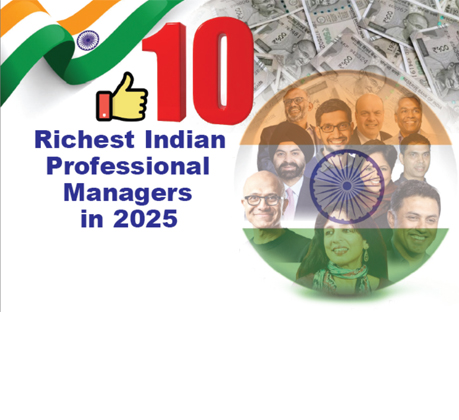

India’s influence on the world economy is no longer defined only by entrepreneurs and family-owned business empires. Increasingly, it is shaped by individuals who have risen through the ranks of global corporations, leading some of the most
powerful companies in technology, finance, retail, and innovation. These are not founders. They are professional managers-people who built wealth through expertise, leadership, and the ability to guide complex organizations on the world
stage.
The Hurun India Rich List 2025 confirms this rise. Sixteen professional executives of Indian origin now hold fortunes exceeding Rs.1,000 crore. Most of them reside in the United States, steering boardrooms that influence global markets.
They are admired not just for personal accomplishment but for reshaping corporate culture, opening pathways for future Indian talent, and demonstrating that leadership can be built-not only inherited.
What makes this year particularly noteworthy is the person who leads the list. The wealthiest Indian-origin corporate executive today is a womansurpassing Silicon Valley giants like Sundar Pichai and Satya Nadella. Her presence at the top
is a symbolic moment in global business, reflecting both the broadening of opportunities and the shifting patterns of power.
1. Jayshree Ullal – CEO, Arista Networks,
Jayshree Ullal, the wealthiest Indian-origin professional manager in 2025, was born in London and raised in Delhi, where she completed her schooling before moving to the United States to pursue higher studies. She earned a bachelor’s degree
in electrical engineering from San Francisco State University and later a master’s degree in engineering management from Santa Clara University. Her early life was shaped by the disciplined, academic environment of her family, where
education and integrity were strongly emphasized. These values would later define her leadership style.
Ullal began her corporate journey at engineering firms and soon joined Cisco Systems, where she spent over 15 years. While at Cisco, she led and scaled the company’s data center, switching, and networking products, helping Cisco grow into a
leader in enterprise networking. In 2008, she took on the role of CEO at Arista Networks, then a young company positioned in the emerging field of cloud network
ing. Under her leadership, Arista transformed into a global powerhouse, providing high-speed data networking solutions for top cloud platforms and data centers. Known for her strategic clarity and quiet authority, Ullal has become an
influential figure in Silicon Valley, proving that leadership can be powerful without being loud. Her success marks a milestone for Indian women in global technology leadership.
2. Satya Nadella – CEO, Microsoft
Satya Nadella was born in Hyderabad, India, in 1967, where he grew up in a middleclass family that emphasized education and curiosity. His father was a civil servant, and his mother was a Sanskrit lecturer. Nadella studied at Hyderabad
Public School and later earned a degree in electrical engineering from Manipal Institute of Technology. Seeking to expand his horizons, he moved to the United States, where he completed a master’s degree in computer science from the
University of Wisconsin- Milwaukee, followed by an MBA from the University of Chicago Booth School of Business. This blend of technical knowledge and business education laid the foundation for his leadership philosophy.
Nadella joined Microsoft in 1992 and steadily rose through the ranks by working in various divisions, including cloud computing, search, and enterprise solutions. When he became CEO in 2014, Microsoft was considered a legacy company
struggling to stay relevant in a rapidly changing tech world. Nadella shifted the company’s focus toward cloud services, artificial intelligence, and collaborative culture. Under his guidance, Microsoft Azure became a global cloud leader,
and the company regained its position among the most valuable enterprises in the world. Nadella is admired for bringing empathy into corporate leadership, demonstrating that strength and humility can coexist at the highest levels of global
business.
3. Nikesh Arora – CEO, Palo Alto Networks
Nikesh Arora was born in Ghaziabad, near Delhi, where he studied at the Air Force School before earning a degree in electrical engineering from IIT BHU. He later moved abroad to pursue an MBA from Northeastern University and acquired
further executive training at the prestigious INSEAD Business School. Arora’s early life was influenced by discipline and aspiration, as his father served in the Indian Air Force. His global educational journey gave him a unique ability to
navigate corporate cultures across continents.
Arora began his professional career in finance and tech advisory roles before joining Google in 2004. At Google, he contributed significantly to the company’s global sales operations and later became Senior Vice- President and Chief
Business Officer. His leadership helped Google expand advertising revenue and global outreach. He later served as President and COO at SoftBank Group, where he played a key role in major global investments. In 2018, Arora became CEO and
Chairman of Palo Alto Networks, a cybersecurity firm crucial to the digital economy. Under his leadership, the company expanded its security platforms and AI-driven threat response solutions. Arora’s career reflects a mastery of scale,
negotiation, and long-term strategic thinking across multiple industries.
4. Ignatius Navil Noronha – CEO, Avenue Supermarts (D-Mart)
Ignatius Navil Noronha is a rare figure among India’s corporate elite: a homegrown business leader who built success entirely within the country. Born and raised in Mumbai, he completed his schooling there before earning amanagement degree
from Mumbai’s Narsee Monjee Institute of Management Studies (NMIMS). Noronha began his career in the fast-moving consumer goods sector at Hindustan Unilever, where he gained insight into the complexity of Indian consumer behavior-knowledge
that would later become the foundation of his success.
Noronha joined Avenue Supermarts, the parent company of D-Mart, at a young age and eventually became CEO. DMart’s business model emphasizes efficiency, affordability, and consistency-qualities deeply aligned with Indian shopping habits.
Noronha’s leadership focused on minimizing costs, maintaining strong supplier relationships, and choosing strategic store locations, avoiding the debt-driven expansion seen in many retail chains. D-Mart grew steadily into one of India’s
most profitable and trusted retail brands. His rise demonstrates that innovation in India does not always come from high technology; it can emerge from thoughtful simplicity and deep understanding of local needs.
5. Ajaypal Singh Banga – President, World Bank Group
Ajay Banga was born in Pune, Maharashtra, into a family with a tradition of service and discipline. His father was a highranking officer in the Indian Army, and Banga spent his early years moving from one cantonment town to another. He
attended St. Edward’s School in Shimla and later graduated from the prestigious St. Stephen’s College in Delhi with a degree in economics. He went on to earn his postgraduate degree from the Indian Institute of Management, Ahmedabad, one of
India’s leading business schools. This academic foundation prepared him for a global career that combined finance, leadership, and cross-cultural collaboration.
Banga began his professional career at Nestlé India, where he spent more than a decade in multiple roles across marketing and general management. He later joined PepsiCo during its expansion phase in India before transitioning to Citigroup,
where he rose to become CEO of the Asia-Pacific region. His most influential tenure came as CEO and later Chairman of Mastercard, where he spearheaded global financial inclusion initiatives and digital payments expansion. In 2023, he was
appointed President of the World Bank Group, where he now leads international economic development strategies. His career underscores the increasing presence of Indian leadership in global governance and multilateral finance.
6. Thomas Kurian – CEO, Google Cloud
Thomas Kurian was born in Bengaluru, Karnataka, and grew up in a family that strongly encouraged academic excellence. He and his twin brother George were both top-ranking students. After finishing school at St. Joseph’s Boys’ High School,
Thomas earned a place at Princeton University, where he studied electrical engineering and computer science. He later pursued an MBA from Stanford Graduate School of Business. This combination of technical expertise and business training
positioned him for influential leadership roles in the technology industry.
Kurian spent more than two decades at Oracle, where he held several senior roles, eventually rising to President of Product Development. He oversaw Oracle’s extensive software portfolio and played a central role in shaping enterprise
software strategies worldwide. In 2019, Kurian became the CEO of Google Cloud. Under his leadership, Google Cloud shifted from a developer- focused platform to a structured enterprise solution provider. He focused on partnerships, sales
expansion, and industry-specific cloud applications, helping Google become a more competitive force in enterprise cloud computing. Kurian’s leadership style is analytical and performance-driven, reflecting his experience in scaling large,
complex technology organizations.
7. Sundar Pichai – CEO, Alphabet and Google
Sundar Pichai was born in Madurai, Tamil Nadu, and grew up in Chennai in a modest household where his father worked as an electrical engineer in a factory and his mother was a stenographer. He attended Jawahar Vidyalaya and then IIT
Kharagpur, where he earned a degree in metallurgical engineering. His academic excellence earned him a scholarship to Stanford University, where he studied materials science and engineering. He later earned an MBA from the Wharton School,
where he was recognized as a Siebel Scholar and Palmer Scholar for outstanding academic performance.
Pichai joined Google in 2004, initially working on the Google Toolbar and later leading the development of Google Chrome, which would become the world’s most widely used internet browser. His strategic vision and calm leadership led to
increasingly senior roles, culminating in his appointment as CEO of Google in 2015 and CEO of Alphabet, the parent company, in 2019. Pichai has guided the company through major technology transitions, including artificial intelligence
advances, regulatory scrutiny, and global expansion. He is known for his patient, inclusive leadership and his ability to align large teams behind complex strategic goals.
8. Indra K. Nooyi – Former CEO, PepsiCo
Indra Nooyi was born in Chennai, Tamil Nadu, into a middle-class family that valued education and cultural discipline. She attended Holy Angels Anglo Indian Higher Secondary School and went on to study physics, chemistry, and mathematics at Madras Christian College. She completed her MBA at the Indian Institute of Management, Calcutta,
before moving to the United States to study public and private management at Yale School of Management. Her academic journey reflects her intellectual rigor and global ambition. Nooyi began her career in product management roles in India
before joining the Boston Consulting Group in the United States. She later held senior strategic planning roles at Motorola and Asea Brown Boveri before joining PepsiCo in 1994. Rising through the leadership ranks, she became CEO in 2006.
During her tenure, she reoriented PepsiCo toward sustainability and healthfocused products, while maintaining global brand strength. Nooyi emphasized responsible growth by investing in communities, environmental initiatives, and nutritional
product lines. Widely regarded as one of the most influential women in corporate history, her leadership continues to shape discussions around diversity, strategic vision, and purpose-driven business.
9. Shantanu Narayen – CEO, Adobe
Shantanu Narayen was born in Hyderabad, where he attended Hyderabad Public School before earning a degree in electronics and communication engineering from Osmania University. He later moved to the United States, completing a master’s
degree in computer science from Bowling Green State University and an MBA from the University of California, Berkeley. His career is built upon a strong foundation of both technical and managerial expertise. Narayen joined Adobe in 1998 and
played crucial roles in product strategy and engineering before becoming CEO in 2007. Under his leadership, Adobe underwent one of the most significant business transformations in the technology sector: shifting from physical software
packages to subscriptionbased cloud services. This move not only modernized Adobe’s business model but also positioned the company at the center of digital creativity and marketing technology ecosystems. Narayen is known for his patient,
long-term perspective and his focus on empowering digital communities worldwide. His leadership has made Adobe indispensable to creative professionals and enterprises alike.
10. Ajit Jain – Vice Chairman, Insurance Operations, Berkshire Hathaway
Ajit Jain was born in Odisha, India, and earned his degree in engineering from IIT Kharagpur, one of India’s most competitive technical institutions. He later completed an MBA from Harvard Business School, a transition that shifted his
career toward finance and strategic management. Jain began his career at IBM before joining American International Group (AIG), where he developed expertise in insurance underwriting.
In 1986, he joined Berkshire Hathaway, where he rapidly became one of Warren Buffett’s most trusted advisors. Jain built Berkshire’s reinsurance group into a major global business known for disciplined risk assessment and analytical rigor.
His leadership style is understated and execution-driven, focusing on longterm performance rather than shortterm gains. In 2018, he was appointed Vice Chairman of Insurance Operations, formally recognizing his decades of contribution to
Berkshire Hathaway’s growth. Jain remains a central figure in one of the world’s most respected investment organizations, known for judgment, precision, and deep understanding of financial risk.





Add Comment