







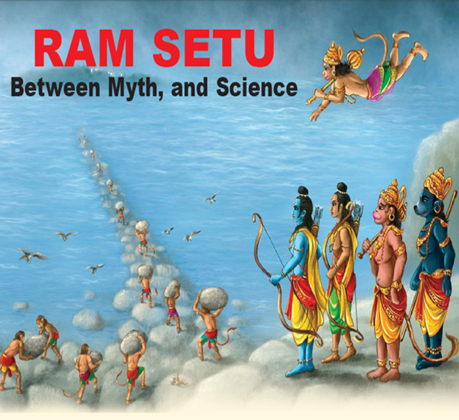

The Ram Setu, also known as Adam’s Bridge, is a chain of limestone shoals stretching between Pamban Island off Tamil Nadu and Mannar Island off Sri Lanka. For centuries, it has been a site of fascination, blending mythology, geopolitics,
and environmental concerns. Hindu tradition holds that the bridge was built by an army of monkeys led by Lord Hanuman to help Lord Ram rescue his wife Sita from the demon king Ravan. Meanwhile, in Abrahamic traditions, it is believed to be
Adam’s footprints, giving it the name Adam’s Bridge. Beyond its mythological significance, the bridge has long been of strategic interest.
British colonial planners in the 19th century considered dredging the channel to allow larger ships to navigate between India’s east and west coasts. Their plans, however, were abandoned due to technical and ecological challenges.
When India became independent, the Sethusamudram Project revived these proposals, aiming to create a navigable canal connecting the Palk Strait. Opposition soon arose from groups asserting the bridge’s sacred status in the Ramayana, sparking a political and cultural debate that continues today. Interestingly, the British approach to Ram
Setu contrasted with their general disregard for Indian religious beliefs. According to Professor Arup K. Chatterjee, colonial geologists maintained “epistemic humility,” neither affirming nor denying the myths. German geologist Johannes
Walther, who studied the bridge in 1891, noted that while the geological origins of the shoals were inexplicable, he could not comment on the myth’s veracity. The Geological Survey of India similarly published reports highlighting the
bridge’s unusual formation, emphasizing that while they could not confirm Ram’s existence, the mythology could not be dismissed outright. Colonial interest in the bridge was intertwined with the desire to improve navigation in the Palk
Strait.
Surveys repeatedly concluded that dredging would be prohibitively expensive, the shoals unstable for six months of the year, and the channel complicated by opposing water flows. Ultimately, these practical and ecological considerations,
combined with respect for the myth, ensured that the Adam’s Bridge remained undisturbed. The Pamban Bridge, built in 1914, became India’s first major sea bridge, connecting the mainland to Rameshwaram just 30 kilometers north of the Ram
Setu. Post-independence, the Sethusamudram Project was first proposed in 1955 but stalled repeatedly due to ecological, financial, and religious concerns. Renewed interest came in the 1980s and 1990s, with Tamil Nadu and later central
governments proposing dredging the channel. By 2004, under the UPA government, dredging began, sparking immediate opposition from Hindu nationalist groups. Subramanian Swamy filed petitions in the Supreme Court, arguing the bridge’s
sanctity, while the government questioned the existence of Ram Setu in court affidavits, dismissing it as mythology. The controversy also extended to scientific claims. In 1997, the RSS used NASA images to assert the existence of the bridge
and to claim it was 1.75 million years old, corresponding to the Ramayana timeline. NASA later clarified that the images were misrepresented and that the shoals were natural formations. In 2007, the Archaeological Survey of India declared
Ram Setu a natural structure, supporting the government’s stance. In 2021, the Modi government announced a three-year scientific expedition to study whether the formation could be man-made and its correlation with the Ramayana. Scholars
note that the popular understanding of Ram Setu’s location differs from Valmiki’s descriptions. Historian Nilesh Nilkanth Oak suggests the Vanara Sena likely traveled through the Western Ghats to reach the southern Kerala region, from which
Hanuman then leapt to Lanka. The name “Ram Setu” itself became popular later; in the epics, it was originally called Nala Setu, named after Nala, the vanara engineer who constructed the bridge. Despite these historical and geographic
debates, the bridge remains deeply symbolic. As Oak observes, regardless of its precise location or origins, Ram Setu holds the same cultural and spiritual significance for Hindus. Today, the bridge sits at the intersection of faith,
politics, and environmental debate, a reminder that myth, history, and identity often intertwine in ways that science alone cannot fully explain. Ram Setu is thus more than a geological formation. It is a living testament to India’s complex
past, where mythology, colonial history, modern politics, and religious devotion converge. Whether natural or man-made, sacred or strategic, it continues to captivate imaginations, anchor cultural identity, and provoke debates that show no
sign of fading.





Add Comment