



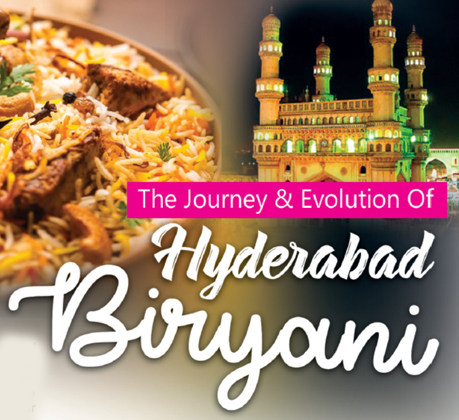

The Journey & Evolution of The 400-year-old city of Hyderabad is linked in popular mind for its signature biryani as much as it is with the exquisitely constructed Charminar monument. The biryani may have become a local landmark, but that doesn’t stop people from
asking, “Where did it come to India from and when?”The lazy “scholars” are quick to opine that it was the genius of Indian people who transformed the “Cinderella of Central Asian pilaff” into the sparkling biryani, but it is difficult to
buy this “thesis”.
There can be little doubt that biryani originated in Iran. Even the name biryani can be traced to the original Persian “birinj biriyan” – literally, fried rice. In Iran, the deg (pot) is put on dum (slow cooking to allow the marinated meat
to cook in its own juices and perfectly with layered rice and aromatic substances), and the rice is gently fried. The doyenne of Islamic cooking in India, Salma Hussein, tells us however that the biryani sold on the streets in contemporary
Iran no longer contains rice and has evolved into succulent chunks of meat cooked in an envelope of rumali roti (paper thin bread).
But the dish has also evolved in India, where it has a colourful and varied history. There is no evidence that biryani first came to this land with the Moguls. It is far more probable that it travelled with pilgrims and soldier-statesmen of
noble descent to the Deccan region in south India. It was only much later that the dish meandered along less travelled roads, along the seaboard and the hinterland of the peninsula, donning different local garbs to tickle regional palates.
While biryani is popularly associated with the Mughals, there is some historical evidence to show that there were other, similar rice dishes prior to the Mughal invasion. There is mention about a rice dish known as “Oon Soru” in Tamil as
early as the year 2 A.D. Oon Soru was composed of rice, ghee, meat, turmeric, coriander, pepper, and bay leaf, and was used to feed military warriors.
Another interesting story traces the origins of the dish to Mumtaz Mahal(1593-1631), Shah Jahan’s queen who inspired the Taj Mahal. It is said that she once visited army barracks and found the army personnel under-nourished. She asked the
chef to prepare a special dish which provided balanced nutrition, and thus the biryani was created. The famous traveler and historian Al-Biruni has precise descriptions of meals at the courts of Sultans who ruled parts of India prior to the
Mughals. These also contain mentions of rice dishes similar to the Mughal biryani. However, there is no doubt that Islamic Persians inspired and popularized When the British deposed Nawab Wajid Ali Shah to Kolkata (formerly Calcutta), the
Calcutta biryani was created. Nizams governing small territories in Northern India encouraged regional variants like the Hyderabadi biryani and the Arcot Nawab biryani. Biryani recipes of the Mughals can still be found in places where their
empire had a foothold.
Most people do not know the real biryani
A far more robust biryani – flavourful and satisfying – continues to be cooked in [the central city of] Bhopal where another strain may have come with the Durrani Afghans who once wore the colours of Ahmed Shah Abdali’s army. Then there is
the Moradabadi biryani (made in Moradabad city in the northern state of Uttar Pradesh) that has suddenly (re)surfaced in the capital, Delhi. And the best example of the “Rajasthani improvisation on the biryani theme” is arguably the deg
prepared for the devout pilgrims at Garib Nawaz ki Dargah at the popular Ajmer Sharif Sufi shrine. In present day Kerala for instance, one encounters the Malabar/Mopla biryani. At times it substitutes meat and chicken in favour of fish or
prawn. The spicing is stronger here and its proponents do not miss the aromatic symphony associated with the Hyderabadi product.
In far off West Bengal, the Dhakai version of the dish from the Bangladeshi capital is no less seductive. It is not unreasonable to suggest that the biryani could have traversed the sea route to reach this port city, which was once ruled by
nawabs (Mughal princes). And along the west coast, the milder Bohri biryani has many die hard patrons.





Add Comment