




Stand for a moment on an ancient Roman quay and listen: bales of cotton whisper as they’re hoisted from hull to cart;
pepper rattles in amphorae; muslin, so sheer it seems woven from mist, slips through a merchant’s fingers. Rome is
enthralled, and the thread that binds its appetite to supply runs not across sand but over sea. With The Golden Road:
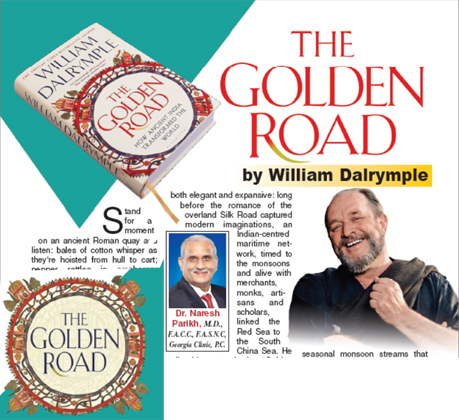
How Ancient India Transformed the World, William Dalrymple invites us to rediscover that ocean highway and to rethink
the map of antiquity itself.
What emerges is a gloriously connective vision of the past, one where India is not a periphery to someone else’s story
but an inexhaustible source of goods, stories, sciences, and states of mind.
Dalrymple’s central proposition is both elegant and expansive: long before the romance of the overland Silk Road
captured modern imaginations, an Indian-centred maritime network, timed to the monsoons and alive with merchants, monks,
artisans and scholars, linked the Red Sea to the South China Sea. He calls this network the “Golden Road.” Through its
ports and sealanes, Indian textiles and spices seduced imperial palates, Sanskrit epics seeded new literatures, Buddhism
and Hindu statecraft found far-flung homes, and placevalue numerals (including that astonishing placeholder we call
zero) crossed languages and continents. The result, Dalrymple shows, was an “Indosphere” whose reach and resilience
shaped more than half the world’s population, then and now.
When the sea stitched a world together
Part of the book’s joy is logistical. Dalrymple makes the wind a protagonist: those steady, seasonal monsoon streams
that turned the Indian Ocean into a navigable superhighway. He lingers in cave-monasteries along the Deccan coast that
doubled as warehouses; he unrolls papyri and inscriptions that capture contracts, cargoes, and quarrels.
Bit by bit, a different map swims into view. The sea doesn’t divide; it unites. A ship from Muziris can ride a July wind
straight to the Red Sea, return on the winter reversal, and make a mockery of the slow plod of caravans. In that small
shift of perspective lies the book’s largest reward: a world reimagined as littoral, cosmopolitan, and impatient with
borders.
That maritime reorientation grounds everything that follows. It explains Roman astonishment at the speed and scale of
the East- West trade, and it clarifies why Indian goods weren’t mere luxuries but market-makers. Pepper becomes more
than spice; it is a habit. Cotton is not just cloth; it is a desire encoded in fibre. Pliny the Elder’s famous splutter
about precious metals draining toward India gains texture in Dalrymple’s telling: we see why the flow happened and how
Indian ports, guilds, and craftspeople were ready for it.
Stories that sailed, and stayed
Across these sea-lanes, ideas travelled as surely as cargo. The Golden Road is at once an economic history and a
cultural atlas, and nowhere is Dalrymple more enchanting than in following literature on the move. He traces the breath
of Sanskrit epics as they cross brackish waters to new courts, and he delights in the stories’ afterlives: Indian animal
fables that surface in Aesop’s repertoire; Buddhist parables that later blossom in Sufi teaching tales; a game we call
chess that passes from India into Persia and beyond. This is cultural diffusion not as lecture but as adventure, the
kind of narrative where a monk’s saddlebag may hold, quite literally, a library that will tilt a civilization’s future.
The book’s portrait of Xuanzang, the seventh-century Chinese pilgrim- scholar, is especially vivid. Dalrymple renders
him not merely as a saint of persistence, but as a precise ethnographer of the subcontinent’s learning. Xuanzang’s
seventeen-year odyssey, culminating in his studies at Nalanda, then the most sparkling hub of scholarly life, becomes a
parable of the Golden Road’s magnetic pull. When he returns to Chang’an, his bundles of sutras and his meticulous
memoirs are not trinkets; they are seeds. Soon, translation workshops hum; monasteries multiply; Chinese Buddhism
absorbs Indian logic while evolving in unmistakably local directions. Dalrymple shows how such moments crystallised
across Asia: Indian ideas absorbed, adapted, and loved into new forms.
Temples that re-sketched the sacred
If books let ideas travel, architecture makes them stay. Dalrymple is a superb guide to places where stone out-argues
text. At Borobudur in Java, a mountain of carved devotion rising from volcanic soil-he traces a Buddhist cosmology
spiralling outward in reliefs and terraces, a pilgrim’s progress chiseled in lava. At Angkor in Cambodia, a
city-ascosmos proclaims Hindu political theology at a scale few courts anywhere dared to match. Both monuments lie
outside modern India. Both, as Dalrymple delights in showing, are saturated with Indian conceptions reimagined by local genius. The result is not derivative but incandescent: courtly cultures that took Sanskrit names and Indic gods yet remained irreducibly Javanese or Khmer. This is the Indosphere at its most persuasive, open-handed, generative, full of vernacular splendour
Courts that hungered for learning
Dalrymple’s eye is equally sharp when the Golden Road turns north and west into the high caliphal world. In Baghdad, the Abbasid “House of Wisdom” and the Barmakid viziers, heirs, intriguingly, to a Buddhist lineage from Balkh, become portals through which Indian astronomical handbooks, medical compendia, and mathematical techniques enter Arabic. The scene hums with intellectual hospitality: a Sanskrit treatise adapted into new terms, tables recalculated for a different meridian, court physicians comparing diagnoses across traditions, number-forms becoming truly global. From there, via Spain and Sicily, those sciences enter Latin Europe and help to midwife a new era of reckoning and reason.
Dalrymple does more than list transmissions; he knits them into human stories. He lingers over an Indian physician known to Arabic sources as “Manka”, working in a Baghdad hospital. He sketches scholars on both sides of the Persianate world reconciling calendars, arguing about omens, measuring the sky. Such portraits, accumulated chapter by chapter, make the book’s larger point felt, not merely stated: Indian learning travelled because it was useful and beautiful, because it helped people make sense of their cosmos and their accounts.
A historian who writes like a novelist
All of this is delivered in prose that moves. Dalrymple is a natural storyteller with a painter’s eye. Ports bustle, forests breathe, and in a few clean strokes, he can make a coin hoard or an inscription feel like a voice. The book’s structure, which pairs a pacy, 300-page narrative with a vast trove of notes and bibliography, keeps it accessible while making plain the depth of reading that supports it. You can enjoy The Golden Road as a feast of scenes; you can also treat it as a map for further exploration. Few writers manage that double gift.
His handling of breadth is equally deft. The canvas is wide: Rome’s craving for Indian luxuries; the Deccan’s cave-monasteries that became entrepôts; Tamil guilds whose signatures show up in faraway inscriptions; the Chinese court under Empress Wu Zetian, where Buddhist prophecy and politics danced a waltz of mutual benefit. Yet the narrative never feels scattered. It returns, like a sailor counting winds, to anchoring themes: trade as the engine of exchange; religion as a portable technology of meaning and legitimacy; science as a set of tools that flourish in translation; story as civilization’s most reliable courier.
Rethinking “soft power,” ancient-style
One of Dalrymple’s most compelling contributions is to liberate “soft power” from modern cliché and show how it worked in antiquity. Armies did march in the Indian Ocean world, but the book’s emphasis is on seduction rather than subjugation. Courts chose Sanskrit because it dignified their rule; artisans borrowed iconographies because they captivated local tastes; scholars adopted algorithms because they worked better. The Golden Road, in this telling, is a highway of willingness. It shows how influence looks when it is pulled, not pushed, when societies reach for ideas because those ideas help them think, govern, and imagine more capaciously.
That emphasis yields an unexpectedly contemporary resonance. In a world often tempted by narrowness, The Golden Road is a reminder that creativity thrives in contact. The ancient India that Dalrymple recovers is open and hybrid: curious about foreign courts, generous with its exports, unafraid to learn and to teach. The book’s final pages gesture gently toward the present, suggesting that India’s most brilliant historical phases were its most connected ones. It is a hopeful lesson, drawn not from nostalgia but from evidence.
A new mental map-rich in vistas, generous in spirit
For general readers, the book offers a cascade of “I didn’t know that” moments that accumulate into a transformed mental map. Why does Indonesia’s national airline take its name from Garuda, Vishnu’s mount? Why does Cambodia’s greatest temple complex enshrine Indian deities? How did a small clay token, the zero, rewrite the arithmetic of entire continents? Dalrymple doesn’t simply answer; he sets the answers in motion across seas and centuries, so that each fact becomes a waypoint on a longer voyage.
For students and specialists, The Golden Road provides a handsome synthesis that foregrounds maritime history and cultural translation without slighting the delights of narrative. It makes space for the craft of art history, bas-reliefs and bronzes, and for the textures of text, edicts, sutras, chronicles, without losing sight of the traders, translators, and travelers who carried them. It honours scholarship while remaining, crucially, a book to read for pleasure.
Why this book matters now
The achievement of The Golden Road lies not only in the arguments it advances, but in the sensibility it models. Dalrymple writes with admiration, for the patience of monks, the skill of shipwrights, the sophistication of merchants, the ambition of kings, and that admiration is contagious. He treats the past as a conversation among equals, not a competition among chauvinisms. The Indosphere he evokes is capacious, made of borrowings that enrich both giver and receiver. In his telling, everyone wins: Rome with pepper on its tongue; Java with a cosmic mountain in stone; Baghdad with new ways to count and to heal; China with a Buddhism reborn in its own accent; India with the confidence of a culture at home abroad.
This spirit gives the book its afterglow. When you close it, you may find yourself measuring distance in seasons rather than miles, hearing winds as schedules rather than obstacles, and noticing, in place names, in rituals, in artefacts, the traces of an India that travelled without losing itself. You may also feel newly protective of the institutions that made such travel meaningful: libraries like Nalanda, where curiosity felt like citizenship; port cities where difference was a daily, practical asset; translation circles where scholars turned hospitality into knowledge.
Verdict
The Golden Road is the rare history that both enlarges the past and lightens the present. It restores India to the centre of a world it helped to make, through trade and tale, temple and theorem, while inviting readers everywhere to take pride in a shared inheritance. Dalrymple’s storytelling is unfailingly clear; his scenes are beautiful; his synthesis is generous. Most of all, his book is animated by a deep respect: for India’s capacity to attract and transform, and for the countless people, named and unnamed, who made an ocean into a road.
Read it for its panoramic sweep. Read it for its intimate moments, the monk at a desk, the mason on a scaffold, the captain watching a wind shift. Read it because it offers, in an age narrowed by noise, a capacious way to think about connection. The world that The Golden Road reveals is older than our arguments and bigger than our borders, and Dalrymple has given it back to us with grace. The Golden Road: How Ancient India Transformed the World by William Dalrymple (Bloomsbury £30 pp496).
– Dr. Naresh Parikh


Add Comment