



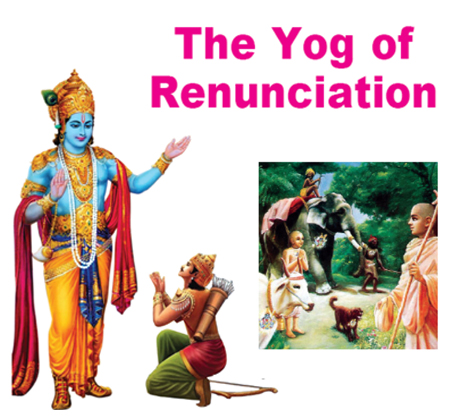

The Bhagavad Gita, or the “Song of God,” is one of the most revered texts in Indian philosophy. Delivered by Lord Shree
Krishna to Arjun on the eve of the great war of the Mahabharata, it is more than a battlefield dialogue. It is a
spiritual guide, a manual on life, and a timeless meditation on duty, righteousness, and the search for truth. Composed
of 18 chapters, the Gita explores paths of devotion, wisdom, discipline, and action, weaving them into a vision of
harmony between worldly responsibilities and spiritual liberation. In the fifth chapter of the Bhagavad Gita, often
called The Yog of Renunciation, Krishna turns to a question that has echoed through centuries of spiritual inquiry: is a
meaningful life found in withdrawing from the world or in participating fully in it? Arjuna, still seeking clarity, asks
whether it is better to renounce all action altogether or to continue acting while maintaining inward discipline.
Krishna’s response is both subtle and practical, offering guidance that remains deeply relevant today.
Krishna explains that both paths-karm sanyas (renouncing action) and karm yog (acting with devotion and detachment)-can ultimately lead toward the same state of liberation. However, the path of renunciation requires a mind that is already
purified of ego, expectation, and emotional reactivity. Re nouncing external action without first renouncing internal attachment risks merely suppressing desires, not dissolving them. Most people, Krishna says, achieve clarity not by
stepping away from life, but by learning how to move through it differently. In karm yog, individuals continue to carry out their responsibilities-family commitments, work, community engagement-but without tying their identity to the
outcomes. They act sincerely, but they do not cling to success or collapse in failure. Their actions are seen as offerings, not transactions. This way of living turns daily routine into a form of meditation.
Krishna uses a simple but elegant metaphor. A lotus leaf rests in water but does not absorb it. In the same way, one who practices karm yog participates actively in the world yet remains inwardly untouched by its fluctuations. The world
continues; obligations continue; but the sense of “I am the one doing everything” begins to fall away. This shift in perspective fundamentally changes how one sees others. Krishna describes the learned person as someone who sees the same
divine presence in all beings-whether it is a priest, a cow, an elephant, a dog, or someone living at the margins of society. This is not mere moral tolerance; it is a deep recognition that dignity does not depend on status, education, or
culture. Spiritual maturity, according to Krishna, expresses itself in the ability to perceive unity beneath social difference.
Such a person does not look to external pleasures for happiness. The Gita recognizes something that modern psychology now frequently emphasizes: sensory pleasure often creates the same cycle of craving and dissatisfaction that keeps people
restless. Enjoyment comes, it fades, and then desire appears again. The karm yogi turns instead toward a quieter joy, one that arises from a steady relationship with the inner self.
After establishing the value of working in the world with awareness, Krishna turns to the path of karm sanyas, the renunciation of action. This is not simply abandoning one’s home or occupation. True renunciation means calming the mind so
thoroughly that the pulls of desire, anger, and fear no longer drive behavior. One who follows this path trains the intellect, disciplines the senses, and reduces dependence on external validation. Withdrawal, in this context, is not
escape-it is refinement.
Yet Krishna is direct: such renunciation is extremely difficult for most people unless it grows naturally after years of selfless engagement. For those who have not yet tempered their inner world, withdrawing from responsibility can
intensify inner conflict rather than resolve it. For this reason, he repeatedly emphasizes that acting with devotion is usually the more accessible path. It is life itself that becomes the teacher.
Krishna then describes one of the most transformative ideas in the chapter: the individual soul is not the ultimate “doer.” Actions unfold through the body, the senses, and the mind, all of which are shaped by nature and circumstance. When
a person thinks, “I alone am responsible; I alone control outcomes,” they become bound by anxiety and attachment. When they see themselves instead as a participant in a larger flow-responsible for effort but not for final results-they begin
to feel lighter. The same actions may continue, but they are no longer accompanied by strain.
For the person who recognizes this, life becomes peaceful. There is no need to excessively celebrate success or mourn disappointment, because identity is no longer tied to outcomes. Pleasure loses its urgency; pain loses its dominance.
Happiness is no longer pursued outside-it is uncovered inside.
Krishna concludes the chapter with an image of internal stillness. A person who has quieted desire, regulated the breath, softened anger, and centered their attention begins to feel as though the presence they once sought outside has always
been within them. They no longer see God as distant or abstract, but as a friend and companion in the heart. This intimacy dissolves fear and invites a sense of ease, belonging, and freedom.


Add Comment