



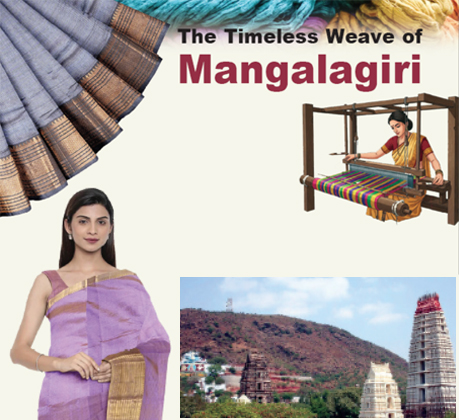

India’s handloom traditions are vast, diverse, and deeply intertwined with its cultural identity. Among these, the textiles of Mangalagiri stand apart for their simplicity, craftsmanship, and historical continuity. Tucked between the hills
of the Eastern Ghats and the banks of the Krishna River, Mangalagiri is a town in Andhra Pradesh that has nurtured a weaving legacy for more than five centuries. The Mangalagiri saree is not just a garment; it is a living document of the
region’s artistic instincts, community livelihood, and devotion.
Located just outside Vijayawada, Mangalagiri’s name literally translates to “Auspicious Hill,” referencing the sacred temple of Panakala Narasimha Swamy that crowns the nearby slopes. For centuries, pilgrims visiting the temple also visited the local weavers’ workshops to purchase cotton and silk textiles. The act of buying a saree from Mangalagiri became both a devotional offering and support for the artisan families who depended on this craft.
This tradition continues today. While modernization and changing fashion trends have reshaped the textile market, Mangalagiri remains an active weaving hub, though the number of weaving families has steadily declined as younger generations
seek alternative livelihoods. Yet, the weavers who remain continue to produce some of the finest cotton textiles in India.
At the heart of the Mangalagiri craft is a distinctive cotton weave known for its smooth, crisp finish. Unlike many other handloom textiles, Mangalagiri fabric is woven using pit looms that are set below ground level. The weaver sits at
floor height, allowing for greater physical stability and even tension, producing fabric that is strong, breathable, and feather-light. Mangalagiri sarees are characterized by: Uncompromised cotton quality, lending durability and comfort.
Firm, even weaving, which gives the fabric its classic crispness. Vibrant, saturated colors achieved through careful dyeing. Wide, embellished borders, traditionally woven with zari. Minimalistic body design that highlights color and
craftsmanship The hallmark is the border. Traditionally called the “Nizam zari border,” it is crafted using gold or silver-toned thread woven tightly into the edge. The body of the saree remains typically plain or follows subtle stripe or
check patterns, letting the border create the central visual impact. This minimal yet striking aesthetic makes the saree suitable for both daily wear and ceremonial occasions.
The journey from cotton fiber to finished saree is long and meticulous. First, raw cotton is spun into yarn and thoroughly cleaned. The yarn is then soaked, dried, and prepared for dyeing. Mangalagiri dyers still practice slow dyeing
techniques that require repeated washing and sun-drying to ensure even color and long-lasting vibrancy.
After dyeing, the warp threads are stretched and aligned, a step requiring patience and skill to prevent breakage. The loom is then assembled, and weaving begins. With each movement of the shuttle, the weaver interlocks warp and weft
threads, constructing fabric layer by layer. After weaving, the saree may be embellished with motifs such as mango, leaf, paisley, or small geometric shapes. These motifs often draw from tribal and temple traditions, grounding the textile
in its cultural landscape.
Every saree is the result of multiple days of labor, concentration, and skill refined through generations. The color palette of Mangalagiri sarees has evolved with time. Where earlier shades leaned towards earthy reds, mustard yellows, and
parrot greens, contemporary versions include lilac, teal, ivory, charcoal, coral, and other modern tones. Yet, the magic of Mangalagiri lies in how its threads blend color visually. When warp and weft threads of different hues are woven
together, the resulting fabric carries a gentle, shimmering color transition that feels organic and expressive. For everyday wear, pure cotton Mangala giri sarees provide breathability and movement ideal for warm climates. For special
occasions, silk Mangalagiri sarees introduce a richer drape and sheen, often paired with more intricate zari motifs. Silk variations maintain the same understated elegance of the cotton originals, making them suitable for weddings,
festivals, and temple ceremonies.
Like many traditional crafts in India, Mangalagiri weaving has faced obstacles. Machine-made fabrics, mass production, and changing consumer habits have reduced demand. Many families that once operated looms now work in other professions.
Yet, there has been a renewed awareness and appreciation for handloom products in recent years. Designers and craft retailers are beginning to highlight Mangalagiri cotton for its versatility and timeless style.
Cities across India and abroad are witnessing a resurgence of handloom clothing among younger consumers who value authenticity and sustainable production. Mangalagiri sarees are increasingly seen in contemporary wardrobes not only for their
comfort but also for their graceful simplicity.
To wear a Mangalagiri saree is to acknowledge the hands that shaped it: the dyer who watched the yarn dry in the shade, the spinner who prepared the thread, the weaver who patiently worked each row, and the artisan community that has kept
this tradition alive for centuries. In an age of rapid consumption and fleeting fashion, Mangalagiri stands for endurance. It stands for craft that respects time. And most of all, it stands for elegance defined not by ornamentation, but by
harmony.


Add Comment