







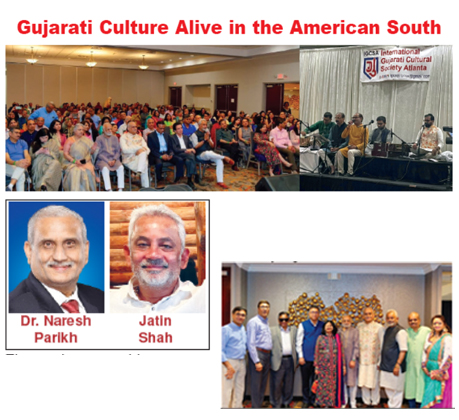

Dr. Naresh Parikh
Jatin Shah
The International Gujarati Cultural Society Atlanta isn’t trying to be flashy. It’s trying to be real. At its core, this nonprofit is about creating a space where Gujaratis in the American South can feel a little closer to home. Not just
through food and festivals, but through language, music, poetry, and the kind of art that makes you pause and feel something.
For a long time, whenever artists from Gujarat toured the U.S., they’d head straight to New Jersey, New York, or California. That left the South out. And for thousands of Gujaratis living in cities like Atlanta, Charlotte, or Birmingham,
that meant missing out on kavi sammelans, sugam sangeet, folk performances, and the evolving styles of Gujarati theatre and storytelling.
That’s the gap this organisation is trying to fill. The Society was formed by a group of passionate individuals who saw the need and decided to do something about it. They want to bring artists from Gujarat and help them tour cities across
the U.S. and Canada, including places that usually get skipped. They also want to give young or lesserknown artists a stage, so they can build an audience and share their work with the wider diaspora.
The board is made up of people with deep roots in both the Gujarati community and professional life in the U.S. Dr. Naresh Parikh, who built a successful medical practice from scratch in Georgia, brings both vision and experience. Jatin
Shah, with a background in real estate and global business, understands how to connect people and ideas across borders. Others like Dr. Dhaval Shah, Mustafa Bhai Ajmeri, and Chirag Thakkar bring a mix of energy and know-how. Rajesh Bhagat
(Texas), Dr. Sanjay Parikh, Dr. Tushar Patel (New Jersey), Nimish Sevak, and Jatin Bhai Shah are part of this team too, each adding their unique strengths and community connections. It’s a team that works because it believes in what it’s doing. One of the big goals is to connect younger generations to their roots. That means designing events that aren’t just for nostalgia, but also speak to what
it means to be a Gujarati today. That includes theme-based shows, experimental plays, and newer forms of music and storytelling. It’s not just about looking back, it’s about staying current. At the same time, there’s space for tradition
too. Poetry recitals, folk songs, and classic dramas are still central. There’s an understanding that culture is layered. You don’t have to pick between old and new, you can hold both. And that’s exactly what the Society is doing.
The International Gujarati Cultural Society Atlanta has already hosted a string of successful events that brought the community together in meaningful ways. One standout evening was the Gujarati Sugam Sangeet concert, where renowned
vocalists from Gujarat performed classic and contemporary songs that resonated deeply with the audience. The auditorium was packed with families, some who drove in from other cities, all drawn by the power of hearing live music in their
mother tongue. Another highlight was the Kavi Sammelan, which featured poets whose words ranged from nostalgic to humorous to socially sharp. The energy in the room that night reminded everyone why Gujarati literature still matters, no
matter where you live.
Equally memorable was the Lok Geet and Dayro program, which transported attendees straight to the villages of Gujarat through folk music, storytelling, and traditional rhythms. The rawness and honesty of the performances struck a chord with
older generations and offered a fresh experience for the youth.
They’re also giving a platform to artists of Gujarati origin who now live in the U.S. These are people who’ve carried their art across oceans and are now ready to share it with audiences who understand the language, the rhythm, and the
sentiment behind every word. And when that happens, when someone hears a poem in their mother tongue or watches a drama that reminds them of growing up in Vadodara or Rajkot, something shifts. The distance feels smaller. That’s the real
work the International Gujarati Cultural Society Atlanta is doing.





Add Comment