






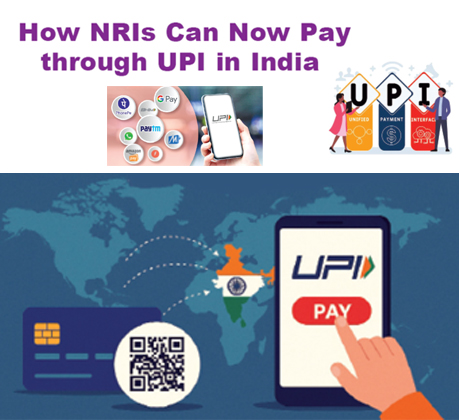

For years, NRIs visiting India faced a frustrating gap in daily convenience: even though UPI payments were everywhere- from autorickshaws to supermarkets-making those same payments required an Indian mobile number linked to an Indian bank
account. This meant that an NRI arriving in India often found themselves borrowing a family member’s phone, paying in cash, or depending on international cards that came with unpredictable conversion charges. That is now changing.
Paytm recently announced that NRIs from 12 countries can log into the Paytm app using their international mobile number and make UPI payments directly from their NRE (Non-Resident External) or NRO (Non-Resident Ordinary) accounts. This
marks one of the most significant expansions of UPI access since the system was launched.
The feature is rolling out in a phased manner and applies to NRIs living in Singapore, Australia, Canada, Hong Kong, Oman, Qatar, the United States, Saudi Arabia, the United Arab Emirates, the United Kingdom, France, and Malaysia. These are
regions with large Indian-origin communitiesand many of them travel frequently between India and their country of residence.
The new system allows NRIs to use Paytm UPI much the same way as residents do. Everyday purchases become smoother: groceries, metro tickets, cabs, street food, pharmacies, and neighborhood stores. Payments no longer need currency conversion
or international card fees. The same UPI QR codes that appear at shops and stalls across India now work for NRIs as well.
For money movement within India, the convenience is significant. Funds can be transferred instantly to friends or relatives with a UPI ID. Bills can be paid directly. An NRI can even send money between their own accounts-such as
transferring from their NRE account to an NRO-linked UPI bank.
To set up the system, NRIs simply need to download the Paytm app and log in using an international mobile number. Verification is done through SMS. Once the number is verified, they can link either their NRE or NRO account. The UPI ID is
then activated, and payments can begin immediately.
This brings up an important distinction
the choice between NRE and NRO matters. An NRE account holds foreign income, while an NRO account is used for earnings generated within India. When a UPI transaction is made, the amount is deducted from whichever account is linked. For
everyday purchases during travel, many choose their NRE account, as balances there are freely repatriable, meaning the remaining funds can be transferred back abroad without restriction. The NRO account, however, has repatriation limits and typically requires additional
documentation to move funds overseas.
The system is also structured to ensure compliance. The NRE or NRO account must already be KYC-verified with the respective bank. UPI is simply the interface for movement, not the storage of funds. No new accounts are created- Paytm simply
provides the UPI layer that was previously restricted.
For NRIs, this update does more than streamline coffee purchases or auto fares. It eliminates a symbolic gap. UPI has become a defining feature of the Indian payment landscape. It is the system that allows vendors selling coconut water or
flower garlands to accept digital payments instantly. For Indians abroad, not having access to UPI meant carrying a logistical reminder of living between two financial worlds. By extending UPI to international mobile numbers and NRE/NRO
accounts, Paytm and NPCI (the National Payments Corporation of India) are working toward a more seamless experience-one where identity across borders is acknowledged rather than fragmented.
There are additional conveniences built into Paytm’s system as well: users can hide transactions when needed, download monthly UPI statements, track spending trends, and view balances across multiple linked accounts in one place. The
interface does not feel different for NRIs; it offers the same functions that domestic users rely on every day.
This move also aligns with a broader global shift. Over the last year, India has been in discussions with several countries to expand UPI-based cross-border payments. The aim is financial mobility for Indians worldwide, especially as
diaspora communities continue to grow and travel patterns deepen.
The most significant shift, however, may be social. The ability to scan a QR code in India-without borrowing a phone or reaching for cash-simplifies everyday interactions. It restores independence. It also brings the NRI experience closer
to what they remember from before leaving India, yet updated to match the technology of today’s India.





Add Comment