







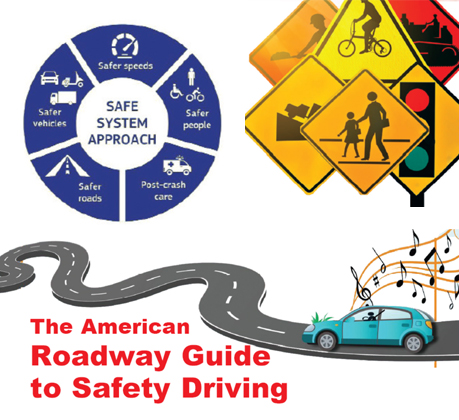

The experience of driving in the United States is a significant part of life for millions, but it also comes with a sobering reality. The human cost of motor vehicle crashes is staggering. In 2021, these incidents led to 46,039 fatalities
and a devastating 2,493,767 injuries, and this toll is on the rise. Beyond the immense personal tragedy, these incidents impose a substantial social cost, estimated at over $500 billion annually. With these numbers on the rise, it’s clear
that the traditional approach to road safety is no longer sufficient.
To confront this crisis, the U.S. Department of Transportation (USDOT) has embraced a new, proactive philosophy: the Safe System Approach. This includes not just road users, but also the engineers who design roads, the policymakers who
create laws, and the healthcare professionals who treat crash victims. This holistic strategy, which has proven successful in other countries, is built on six fundamental principles:
Death and serious injuries are unacceptable: This core belief sets an ambitious goal of zero traffic fatalities and serious injuries.
Humans make mistakes: The system acknowledges that human error is inevitable and designs roads and vehicles to be more forgiving of these errors.
uHumans are vulnerable: Our physical limits are recognised, and measures are put in place to prevent crash forces from exceeding the human body’s tolerance for trauma.
Responsibility is shared: Everyone, from the individual driver to the city planner, shares ensuring safety.
Safety is proactive: The approach focuses on preventing crashes before they happen, rather than simply reacting to them afterward.
Redundancy is crucial: Safety measures are layered, so if one fails, another is there to prevent a tragedy.
Mitigating Risks with a Comprehensive Strategy
The Safe System Approach addresses various elements to reduce the frequency and severity of crashes. These elements include focusing on Safer People, Safer Vehicles, Safer Speeds, Safer Roads, and Post-Crash Care. Safer People: The “Safer
People” pillar of this approach acknowledges that the risk of crashes is not evenly distributed. Certain demographics and behaviors are linked to higher risks, and addressing them requires targeted strategies.
Safer Vehicles: Modern vehicles are equipped with an array of safety features, which can be categorised as either passive or active. Passive safety systems are designed to minimise injury severity during a crash. These include features like
advanced airbags and seat belts with pretensioners that tighten instantly upon impact. Active safety systems, on the other hand, are engineered to prevent a collision altogether. These are often supported by sensors and advanced software
and include technologies like:
Forward-collision warnings: Alerting the driver to an imminent front-end crash.
Lane-departure warnings: Notifying the driver if the vehicle is drifting out of its lane.
Automatic Emergency Braking (AEB): Automatically applying the brakes if a collision is detected and the driver doesn’t react. AEB is expected to become standard in new vehicles by 2029.
Safer Roads: The design of our roads plays a crucial role in crash prevention. For example, intersections are a major point of concern, accounting for over 25% of all traffic fatalities. A proven countermeasure is the use of traffic circles
or roundabouts, which have been shown to reduce fatal and serious injuries at intersections by 70% to 80%.
Safer Speeds: Speeding was a factor in 28% of all fatal crashes in 2021. Research shows that driving just 10 to 15 miles per hour above the speed limit can double the risk of a fatal crash. To enforce speed limits and reduce dangerous
driving, authorities are increasingly using high-visibility enforcement and automated systems, such as cameras and sensors, to detect and ticket violations.
Post-Crash Care: The final pillar focuses on the medical response after a crash. Prompt and effective medical care is vital for survival. Data reveals a stark disparity between rural and urban areas: while only 10% of urban crash victims
face a wait of one to two hours before reaching a hospital, that number skyrockets to 59% for victims in rural areas. This highlights the need for strategic placement of healthcare facilities and improved emergency response protocols,
especially in rural communities. Technology also plays a vital role; crash notification systems can automatically alert emergency services, providing them with critical details about the crash to ensure a more prepared and rapid response.
Navigating the System: A Guide for Non-Citizens & Residents
For international visitors and new residents, understanding the rules for driving in the U.S. is essential. The requirements vary depending on your status and the state you’re in.
Driving as a Visitor
Depending on which U.S. states you visit, you may need an International Driving Permit (IDP) in addition to a driver’s license from your home country. An IDP is a form of identification recognised by many countries worldwide that allows you
to legally drive in a different country. You must get an IDP before your trip, as the U.S. does not issue them to foreign visitors. To obtain one, you should contact the motor vehicle department of the country that issued your driver’s
license. IDPs issued for use in the U.S. are valid for one year.
It is important to check with your country’s embassy or the motor vehicle agency for each U.S. state you plan to drive in to see if an IDP is required. For instance, in most U.S. states, Indian tourists can legally drive rental cars for up
to one year using their valid Indian driving license, provided it is in English. It’s also crucial to carry the I-94 form, which records your date of entry, to help clarify your duration of stay if you are stopped by local authorities.
Additionally, many car rental companies may require both your license and an IDP, so it’s best to check their specific policies in advance.
Acquiring a Driver’s License as a Permanent Resident
If you are a citizen of another country and are living permanently in the U.S., you may be eligible to apply for a driver’s license from the state where you reside. The specific residency requirements differ by state, so you should contact
your local state department of motor vehicles for details on their ID requirements and application process. A state driver’s license allows you to drive anywhere in the U.S.
When you apply, be sure to bring original copies of the following documents:
- All signed versions of your Form I-20, “Certificate of Eligibility for Nonimmigrant Student Status.”
- A valid passport and your most recent student visa (or note that a visa isn’t needed if you are from a visa-exempt country like Canada or Bermuda).
- Proof of residence, which varies from state to state. uIf your state requires it, an SSN card or a Form SSA-L676, “Refusal to Process SSN Application.”
- If you are on optional practical training, your Form I-766, “Employment Authorisation Document.”
- If you are an F-2, M-2, or J-2 dependent, you and your primary F-1, M-1, or J-1 must go to the DMV together with all required documents.





Add Comment