







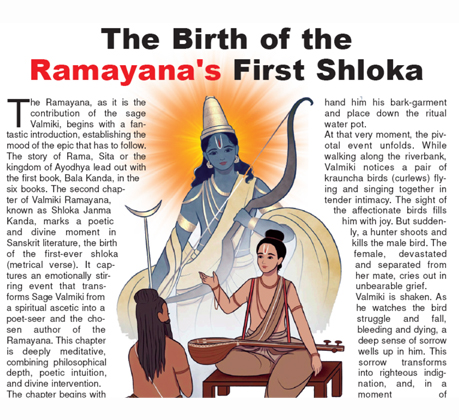

The Ramayana, as it is the contribution of the sage Valmiki, begins with a fantastic introduction, establishing the mood of the epic that has to follow. The story of Rama, Sita or the kingdom of Ayodhya lead out with the first book, Bala
Kanda, in the six books. The second chapter of Valmiki Ramayana, known as Shloka Janma Kanda, marks a poetic and divine moment in Sanskrit literature, the birth of the first-ever shloka (metrical verse). It captures an emotionally stirring
event that transforms Sage Valmiki from a spiritual ascetic into a poet-seer and the chosen author of the Ramayana. This chapter is deeply meditative, combining philosophical depth, poetic intuition, and divine intervention. The chapter
begins with Sage Valmiki, recently visited by the divine sage Narada, contemplating on Rama’s ideal life.
Narada had recounted the virtuous qualities and heroic deeds of Rama. Deeply inspired and disturbed by the realities of human suffering and righteousness, Valmiki proceeds for a ritual bath at the banks of River Tamasa, accompanied by his disciple Bharadwaja.
As they arrive at the serene and clear riverbank, Valmiki praises the clarity and sanctity of the waters, comparing it to a virtuous man’s mind, untainted, calm, and pleasant. He prepares for his ritual bath, asking his disciple to hand him
his bark-garment and place down the ritual water pot.
At that very moment, the pivotal event unfolds. While walking along the riverbank, Valmiki notices a pair of krauncha birds (curlews) flying and singing together in tender intimacy. The sight of the affectionate birds fills him with joy.
But suddenly, a hunter shoots and kills the male bird. The female, devastated and separated from her mate, cries out in unbearable grief. Valmiki is shaken. As he watches the bird struggle and fall, bleeding and dying, a deep sense of
sorrow wells up in him. This sorrow transforms into righteous indignation, and, in a moment of spontaneous emotion, he curses the hunter:
“O cruel hunter, for killing one of the loving krauncha pair, intoxicated with love, may you never find peace or rest for endless years to come!”
This utterance shocks Valmiki. It was unlike anything he had spoken before, so rhythmic, so musical, so balanced. It came naturally, born from grief yet shaped with beauty and rhythm. Bharadwaja, his disciple, too, is awed by the form of
these words.
Valmiki reflects on this verse deeply, struck by the realisation that his emotional anguish had taken the shape of a perfectly structured poetic meter. The verse had four quarters, each consisting of eight syllables. It aligned with a
specific meter, the Anustubh chhandah, and could be set to music. Thus, it became known as a shloka, a term derived from grief. This verse, born out of personal sorrow, was to become the building block of the Ramayana.
After bathing and returning to his hermitage, still absorbed in thought, Valmiki continues pondering the deeper meaning of the shloka. He finds himself involuntarily reciting it again and again. His thoughts repeatedly return to the tragic
image of the bird and the grief of separation. This intense emotional engagement becomes the soil in which the seeds of Ramayana are sown.
It is at this meditative juncture that the creator god Brahma himself appears before Valmiki. The arrival of Brahma is highly symbolic, he does not wait for worship or invocation but comes of his own will. Valmiki, startled and humbled,
receives him with utmost reverence, offering him water for washing feet, a seat, and traditional respect.
After being seated, Brahma smiles and blesses Valmiki. He reveals that the spontaneous verse he uttered is no ordinary curse, it is the beginning of divine poetry. Brahma tells Valmiki that he has been chosen to compose the life story of
Rama in this very poetic form. He assures Valmiki that every event he needs to recount, the past, present, and even future will be revealed to him with perfect clarity. Valmiki, with Brahma’s blessing, is now ordained as the poet of
Ramayana.
Thus, this chapter doesn’t merely tell a story, it explains the mystical origin of epic poetry in Indian tradition. The shloka, considered the mother of all Sanskrit verse forms, emerges from a moment of moral outrage and compassion.
Valmiki’s reaction to the suffering of a bird becomes the emotional key to narrating Rama’s life, a life also filled with separation, virtue, duty, and sorrow.





Add Comment