







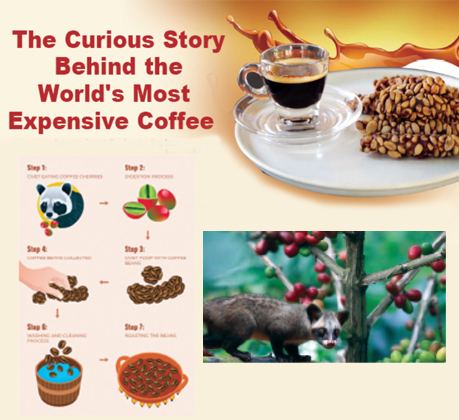

Coffee lovers often talk about aroma, texture, roast depth, and brewing technique as the elements that define a cup’s quality. Even so, there exists a coffee so unusual that its origin story is almost always the first thing mentioned. Kopi
luwak, often called the world’s most expensive coffee, is made from beans that have passed through the digestive tract of the Asian palm civet, a small nocturnal mammal native to parts of Southeast Asia and India. The civet eats ripe coffee
berries, digests the pulp, and excretes the inner seed, which is then collected, cleaned, roasted, and brewed.
For years, the big question has been whether kopi luwak’s high price is justified by taste or simply driven by novelty and rarity. Coffee experts have long debated whether the civet’s role is truly transformative. One idea suggests wild
civets naturally choose the ripest, sweetest berries, meaning the beans they excrete are among the highest quality from a crop. Another view focuses on what happens inside the animal: the bean is exposed to enzymes and fermentation during
digestion, subtly altering its chemical profile.
Recent scientific research supports the second theory. A study examining beans collected from wild civet droppings found notable differences compared to beans taken directly from the same coffee plants. The civet-processed beans contained
higher levels of certain fatty acids that are known to influence aroma and flavor in coffee. These compounds are associated with richer, creamier notes in food and drink. The beans were also slightly larger on average, suggesting wild
civets do preferentially select plumper fruit.
However, the study stopped short of evaluating whether these chemical differences translate into an objectively better-tasting brew. Flavor remains subjective, and expert tasting comparisons were not part of the research. Still, the
findings strongly suggest that the civet’s digestive system acts as a natural fermentation chamber, subtly reshaping the bean’s internal chemistry. The global kopi luwak market has expanded rapidly in recent decades, especially in
Indonesia. But with rising demand came a troubling shift: instead of gathering beans from the droppings of wild civets, many producers now keep civets in cages and feed them coffee cherries in large quantities.
This controlled environment removes the element of selective fruit picking and raises serious ethical concerns. Animal welfare groups have documented cramped living conditions, stress, and long-term harm to the animals. In addition, much of
the kopi luwak sold as “wildsourced” may actually come from these farms.
Ethical considerations aside, kopi luwak’s flavor excellence is still tied to the same fundamentals as any coffee: the freshness of beans, the skill of the roaster, the grind, and the brew method. A poorly executed cup of kopi luwak can be
as unremarkable as any stale or over-extracted coffee. Kopi luwak remains an object of fascination, combining rarity, legend, biology, and taste. But whether it deserves its luxury status depends not just on curiosity, but on conscience,
craftsmanship, and care.





Add Comment