







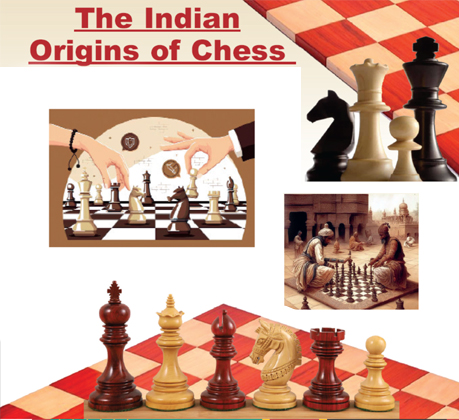

Among the many intellectual contributions of ancient India to the world, one of the most fascinating is the invention of chess, originally known as Chaturanga. Considered the ancestor of modern chess, Chaturanga emerged in Guptaera India
around the 6th century CE and reflects the Indian subcontinent’s deep engagement with strategy, warfare, and philosophy.
The name Chaturanga literally means “four divisions of the army”: infantry, cavalry, elephants, and chariots. These are the direct precursors to the modern chess pieces: pawns, knights, bishops, and rooks. The game was played on an 8×8 grid
called Asht?pada, a board used earlier for dice games. Unlike modern chess, Chaturanga was typically a fourplayer game involving dice, emphasizing both chance and strategy. Over time, it evolved into a two-player version with less reliance
on luck and more on pure tactics. Chaturanga was more than just a pastime; it was a simulation of battle, designed to teach princes and warriors about planning, patience, and foresight. According to some legends, it was invented by a wise
Indian Brahmin to demonstrate the futility of war to a violent king, emphasizing that even the mightiest warriors rely on every unit, no matter how small, to succeed.
One of the most famous anecdotes related to chess’s invention is the “wheat and chessboard” problem. As the story goes, the inventor of the game presented it to a king, who was so impressed that he offered to grant a reward. The inventor
humbly requested grains of wheat, one grain for the first square, two for the second, four for the third, doubling each square until the 64th. The king laughed at the simplicity, until his mathematicians calculated the total: over 18
quintillion grains, more than all the grain in the kingdom. The tale is not just a story about mathematics but about humility, exponential growth, and the power of knowledge.
From India, the game spread to Persia (as Shatranj), and then eventually to Europe. The term “Checkmate” comes from the Persian phrase Shah Mat, meaning “the king is helpless.” Despite its global fame, the Indian origins of chess are often
overlooked. Chaturanga stands as a testament to ancient India’s legacy in mathematics, logic, and strategic thinking, not only in warfare but also in the realm of intellectual play.





Add Comment