







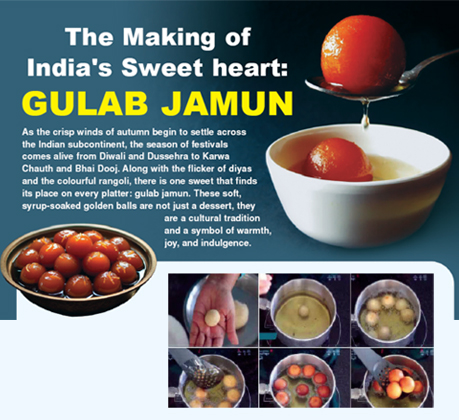

As the crisp winds of autumn begin to settle across the Indian subcontinent, the season of festivals comes alive from Diwali and Dussehra to Karwa Chauth and Bhai Dooj. Along with the flicker of diyas and the colourful rangoli, there is one
sweet that finds its place on every platter: gulab jamun. These soft, syrup-soaked golden balls are not just a dessert, they are a cultural tradition and a symbol of warmth, joy, and indulgence.
Gulab jamun is a beloved Indian sweet made from milk solids, combined with flour to form a dough. The dough is then rolled into small, smooth balls and deep-fried to a rich golden- brown hue. After frying, these balls are soaked in a warm,
fragrant sugar syrup infused with cardamom, rose water, or sometimes saffron. The result is an irresistibly soft, spongy sweet that melts in the mouth and leaves a lasting impression of flavour and nostalgia.
Gulab jamun gets its name from two words: ‘gulab’ (rose water) and ‘jamun’ (a small Indian fruit similar in size and shape to the sweet). Traditionally made with khoya (reduced milk solids), the recipe has evolved to include milk powder for
ease without compromising on taste.
Ingredients:
- 1 cup milk powder
- 2 tablespoons all-purpose flour
- 1/4 teaspoon baking soda
- 2 tablespoons ghee
- 2-3 tablespoons milk (for kneading)
- Oil or ghee for frying
For the syrup:
- 1 ½ cups sugar
- 1 ½ cups water
- 3-4 green cardamom pods
- A few drops of rose water (optional)
- A few strands of saffron (optional)
Cooking Instructions:
In a deep pan, combine sugar and water. Heat until the sugar dissolves, then add cardamom, rose water, and saffron. Let it simmer on low flame for 5-7 minutes. The syrup should be slightly sticky but not thick. Next mix the milk powder,
flour, baking soda, and ghee in a bowl. Add milk little by little to form a soft, sticky dough. Let it rest for 10 minutes. Divide the dough into equal portions and roll them into smooth, crack-free balls. Cracks can cause them to break
while frying. Later, heat oil or ghee in a pan on low to medium flame. Fry the balls slowly until they turn deep golden brown. Don’t overcrowd the pan. Immediately transfer the hot gulab jamuns into the warm sugar syrup. Let them soak for
at least 30 minutes to become soft and juicy. Gulab jamuns are often the centrepiece of a festive thali. Served warm, sometimes garnished with pistachios or edible silver leaf, they represent celebration, hospitality, and home. As each bite
dissolves on the tongue, it speaks of festivals, family, and the sweetness of tradition.





Add Comment