





Marma therapy, an intricate healing system rooted in ancient India, is slowly reclaiming its place in the wider world of holistic wellness. Often described as the “mother of all
pressure-point systems,” it forms one of the oldest branches of Ayurveda and Yoga, predating many forms of massage, acupuncture, and martial arts medicine practiced globally today. Yet for
centuries, its knowledge remained guarded within select Ayurvedic families, Kalaripayattu martial artists, and yogic lineages. Only in recent decades has Marma therapy
stepped out of obscurity, offering modern seekers a gentle yet profound method of healing through the body’s vital energy points.
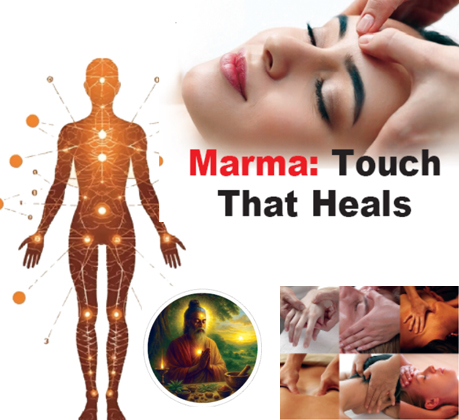
At its core, Marma therapy is based on the concept that the human body contains 107 vital energy points, where the physical, mental, and subtle bodies intersect. These
points-called marmas-are anatomically located at junctions of muscles, ligaments, bones, nerves, and subtle channels (nadis). Ancient scholars believed that life energy
(prana) circulates through these points, influencing everything from organ function to emotional wellbeing.
When a marma point is injured or blocked, disease, pain, and psychological disturbance follow.
When activated skillfully, these same points promote healing, balance, and rejuvenation.
Where Marma Therapy Originated Marma therapy is as old as Ayurveda itself, with references appearing in the Atharva Veda and classical Ayurvedic texts. However,
its most detailed exposition comes from the Sushruta Samhita, composed around 600 BCE by Sushruta-the father of surgery. This monumental text identifies the 107
marma points, describes their structure, and classifies them based on their sensitivity and function.
For Sushruta, knowing the marmas was essential not only for healing but also for safe surgical practice; injury to key points could be fatal.
Thus, Marma therapy stands at a unique intersection of medicine, martial science, and yoga. It emerged not just as a therapeutic practice but also as a way to understand the vulnerabilities
and strengths of the human body. Warriors studied marmas to disable opponents with minimal force, while physicians studied them to restore life.
When and How It Developed
Though marma knowledge existed in the Vedic period, it became systematized during Sushruta’s era. Between 500-300 BCE, India witnessed a flourishing of medical scholarship, much of it compiled in
the three foundational Ayurvedic texts-Charaka Samhita, Sushruta Samhita, and Ashtanga Hridaya. Sushruta’s work contributed to the marma framework, integrating it into surgical practice and therapeutic massage.
By the time Ayurveda reached the classical period (1st-4th centuryCE), Marma therapy was used routinely in: post-surgical care, rehabilitation
after injuries, rejuvenation treatments, pain management, calming mental disturbances, strengthening vital organs, enhancing longevity.
The therapy was gentle yet potent: practitioners applied pressure using fingers, elbows, herbs, medicated oils, or even specific breathing techniques to open the obstructed pathways of
prana. Over time, the marma system expanded into the yogic tradition, where activating certain points supported meditation, breath regulation, and spiritual growth.
Who Developed or Preserved It Although Sushruta formalized the marma system, its preservation owes much to three lineages:
1. Ayurvedic Vaidyas
Traditional Ayurvedic Vaidyas viewed marma points as diagnostic markers and therapeutic gateways. By palpating these subtle junctions, they could assess imbalances in
doshas, detect hidden injuries, and understand emotional disturbances lodged in the body. Treatment often combines gentle marma stimulation with herbal oils, detoxification therapies,
and lifestyle corrections to restore the flow of prana. For Vaidyas, marma therapy was one that treated the person as an integrated whole, where physical ailments,
mental states, and energy pathways were inseparably linked.
2. Kalaripayattu Martial Artists of Kerala
Perhaps the most surprising custodians of marma knowledge were warriors. Kalaripayattu, one of the world’s oldest martial arts, developed a sophisticated understanding
of the marmas for both combat and healing. Masters could incapacitate opponents by targeting marma points with minimal effort. The same expertise, however, was also used
to revive injured fighters and accelerate recovery.
3. Yogis and Siddhar Traditions
Yogic texts describe how pressing certain marmas awakens dormant energy centres, aids breath control, and quietens the mind. Siddhar practitioners of Tamil Nadu further
refined marma therapy into a spiritual discipline. These traditions protected marma knowledge through oral transmission, deliberately restricting access to prevent misuse.
Why Marma Therapy Was Practiced
Marma therapy was not merely a physical treatment; it was conceived as an integrated healing system addressing: physical disorders through improved circulation and
nerve stimulation, energetic imbalances by redirecting prana, mental conditions such as anxiety, fear, lack of clarity, and emotional stagnation,
prevention-keeping vital points open to avoid disease, rejuvenationenhancing vitality, immunity, and longevity, spiritual growth-supporting meditation through subtle-body activation
The marmas served as gateways between the body and the mind, the material and the subtle. Healing them meant healing the whole person.
Despite its deep roots, marma therapy gradually faded from mainstream practice around the medieval period. Several factors contributed: invasions and political
upheavals disrupted traditional learning centres, Ayurvedic knowledge was forced into secrecy, the decline of Kalaripayattu reduced martial applications of marmas,
British colonial rule suppressed indigenous systems of medicine, Western medical education overshadowed Ayurvedic institutions By the 19th century, marma therapy
survived mostly in pockets of Kerala and Tamil Nadu, passed down quietly within families or martial arts schools.
The Revival of Marma Therapy
The late 20th century marked a turning point. As Ayurveda experienced global resurgence, marma therapy began drawing attention again.
Interest came from four directions: Ayurvedic researchers revisiting classical texts, yoga practitioners seeking tools to deepen meditative states, holistic healers discovering
its similarities with acupuncture and reflexology, wellness tourism in Kerala, where marma massage became a sought-after treatment Institutions in India-especially in
Kerala, Karnataka, and Tamil Nadu-began formal training, and international wellness centres incorporated marma techniques into spa therapies and complementary medicine programs.
Today, marma therapy is regarded as: a powerful alternative for chronic pain, a natural tool for stress regulation, a supportive therapy for rehabilitation, a method for energy
balancing, a complement to yoga, breathwork, and meditation. Its noninvasive nature and emphasis on restoring natural balance make it
increasingly attractive in a world overwhelmed by stress, digital fatigue, and lifestyle disorders. As more research explores the anatomical, neurological, and energetic
basis of marma points, Marma therapy is poised for wider recognition. It offers a unique bridge between ancient wisdom and modern wellness, between the physical and the subtle, between touch and transformation.
In a culture searching for gentler healing systems, Marma therapy stands not as a rediscovery but as a return-a reminder of India’s sophisticated understanding of
the human body and its potential for self-healing.




Add Comment