



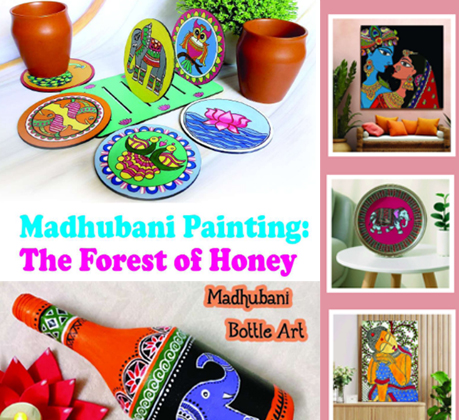

Madhubani painting – born on the mud walls of rural Bihar, now displayed in galleries across the world – is one of India’s oldest and most vibrant living art traditions. The name itself tells a story. Madhubani means “forest of
honey,” and the art that bears its name carries the same qualities – intricate, layered, alive with colour and meaning. Madhubani painting, also known as Mithila painting, is a traditional folk art form originating from the Mithila
region of Bihar in northeastern India. For centuries, it existed quietly on the walls and floors of rural homes, practised almost entirely by women, passed from mother to daughter as a form of domestic ritual and cultural memory. Today, it
is recognised as one of India’s most significant art traditions, awarded a Geographical Indication (GI) tag in 2007 and exhibited in museums from New Delhi to San Francisco.
Ancient Origins
The origins of Madhubani painting are traced, by tradition, to the era of the Ramayana. According to the legend, King Janaka of Mithila commissioned artists to create murals to celebrate the wedding of his daughter Sita to Prince Rama of
Ayodhya. Whether historical or mythological, the connection is telling: from its very inception, Madhubani art has been linked to auspicious occasions – marriages, births, festivals, and religious observances. Women of the Mithila
region painted the walls, floors, and courtyards of their homes to mark these events, using a paste made from powdered rice and pigments drawn from nature.
Rediscovery
In the modern era, Madhubani painting came to wider attention in 1934, when William G. Archer, a British colonial officer stationed in the Madhubani district, encountered these wall paintings in the interiors of homes exposed by
a devastating earthquake that struck Bihar. Archer documented what he found, and his records introduced the art form to audiences beyond the village. However, it was not until the 1960s, when a severe drought brought
economic hardship to the region, that Madhubani painting underwent its most significant transformation. The All India Handicrafts Board encouraged the women of Mithila to recreate their wall paintings on handmade paper, offering them a
source of livelihood during the crisis. This shift – from wall to paper, from domestic ritual to commercial art – brought Madhubani into the public domain and eventually onto the global stage.
Materials and Method
One of the most distinctive aspects of Madhubani painting is the use of natural, organic materials. Traditionally, artists prepared their pigments from readily available sources: turmeric for yellow, indigo for blue, sandalwood or vermilion
for red, leaves for green, and lampblack or burnt rice for black. The tools are equally simple – fingers, twigs, matchsticks, bamboo pens, and nib-pens. Brushes are rarely used. Every painting is characterised by bold outlines,
double-bordered lines, and the complete absence of empty space; the entire surface is filled with patterns, motifs, and symbolic imagery. This horror vacui – the filling of every available area – is one of the art form’s defining visual signatures.
Five Styles
Madhubani painting encompasses five recognised styles, each with its own character. Bharni uses vibrant, filled colours and typically depicts gods, goddesses, and auspicious symbols. Katchni relies on fine, intricate line work, often in monochromatic tones. Tantrik draws on spiritual and religious
symbolism. Kohbar is centred on marriage rituals and themes of fertility and union – it is the style most directly connected to the art form’s legendary origins. Godna, inspired by tattoo traditions, uses simpler motifs and is practised widely across communities. Together, these five styles represent the full expressive range of the tradition.
Themes and Symbols
The subjects of Madhubani painting are drawn from Hindu mythology, nature, and daily life. Scenes from the Ramayana and Mahabharata, depictions of deities such as Krishna, Shiva, Durga, and Saraswati, and celebrations of the natural world –
fish, peacocks, lotus flowers, the sun and moon – are among the most common motifs. Each element carries symbolic meaning: fish represent fertility and prosperity, the lotus signifies good fortune, and peacocks evoke love and
beauty. Social events, particularly weddings and festivals such as Holi, Durga Puja, and Chhath, are also frequently depicted.
Recognition and Impact
Madhubani painting received its first major official recognition in 1969, when Sita Devi of Jitwarpur village was honoured with the Bihar State Award. She later received the Padma Shri in 1981. Jagdamba Devi was awarded the Padma Shri
in 1975, followed by Ganga Devi in 1984 and Mahasundari Devi in 2011. These women – and many others, including Baua Devi, Yamuna Devi, and Bharti Dayal – have been instrumental in carrying Madhubani from village walls to international
exhibitions. In 2018, San Francisco’s Asian Art Museum hosted a dedicated exhibition of Mithila art. The United Nations has featured Madhubani designs in its official collections, including a UNESCO Christmas card series. In 2012, the
art form found an unexpected application in environmental conservation. An NGO called Gram Vikas Parishad employed local painters to cover trees in Bihar with Madhubani motifs – images of gods and sacred figures – as a creative deterrent
against deforestation. The initiative drew national attention and demonstrated how a centuries-old art tradition could serve contemporary causes.
For the Indian diaspora, Madhubani painting represents something increasingly rare: an unbroken line of cultural transmission stretching back centuries, carried forward primarily by the hands and creativity of women. It is an art
form that began as prayer, evolved into livelihood, and now stands as one of India’s most recognised contributions to the world’s folk art heritage. The forest of honey, it turns out, has roots that run very deep.





Add Comment