




When the passes reopen and the high desert comes alive, June offers the ideal window to experience one of the most extraordinary landscapes on Earth.
Ladakh sits at an average elevation of over 3,000 metres in the northernmost reaches of India, a high-altitude desert framed by the Karakoram and Himalayan ranges. For much of the year, heavy snowfall seals its mountain passes and cuts
the region off from overland access. June changes that. The snow recedes, the highways reopen, and the stark, otherworldly terrain – brown valleys, turquoise lakes, ancient monasteries perched on cliffs – becomes fully accessible for the first time since autumn.
Why June
June marks the true beginning of Ladakh’s travel season. Daytime temperatures in Leh hover between 18°C and 25°C, warm enough for comfortable exploration but far cooler than the plains of India, where summer temperatures regularly exceed
40°C. Nights remain brisk, dropping to around 5°C in some areas, so layered clothing is essential. The skies are largely clear, offering exceptional visibility for photography and sightseeing. Crucially, by mid-June both of
Ladakh’s major overland routes – the Srinagar-Leh Highway and the Manali-Leh Highway – are typically open, giving travellers the option of dramatic road journeys through some of the highest motorable passes in the world. For those
preferring to fly, Leh’s Kushok Bakula Rimpochee Airport operates regular flights from Delhi, Srinagar, and other cities.
Where to Go
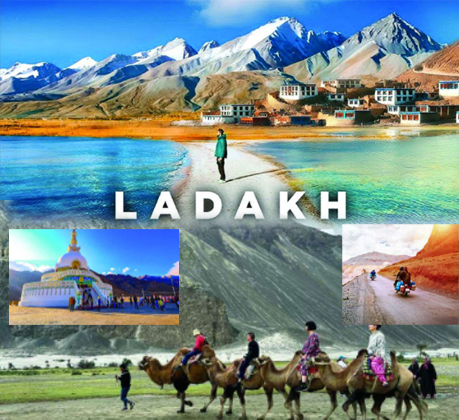
Leh, the regional capital, is the natural starting point. The 17thcentury Leh Palace overlooks the old town and offers panoramic views of the Indus Valley. Shanti Stupa, a white-domed Buddhist monument built in 1991 by a Japanese
Buddhist organisation in collaboration with local communities, is best visited at sunrise or sunset. The bustling Leh Main Bazaar is the place to pick uppashmina shawls, Tibetan jewellery, and dried apricots – a Ladakhi staple.
From Leh, the Sham Valley circuit covers several essential stops: Magnetic Hill, where an optical illusion makes vehicles appear to roll uphill; the sacred confluence of the Zanskar and Indus rivers, where waters of contrasting colours merge visibly; and the ancient monasteries of
Alchi and Likir, both home to centuries-old Buddhist murals and statuary.
Nubra Valley, reached via the Khardung La pass at approximately 5,359 metres, is a landscape of sand dunes, green oases, and Bactrian camels – the doublehumped variety found almost nowhere else in India. The Diskit Monastery, with its
towering Maitreya Buddha statue, and the village of Turtuk, close to the Line of Control, offer a glimpse into the Balti culture of the region.
Pangong Tso, a 134-kilometrelong lake straddling the India- China border, is Ladakh’s most photographed destination. In June, its frozen surface has melted to reveal shifting shades of blue and green depending on the time of day and
angle of sunlight. Accommodation is available in lakeside camps. Tso Moriri, a highaltitude lake further south, is less visited but equally striking – a Ramsar-designated wetland surrounded by snow-capped peaks.
Monasteries and Festivals
heritage, and its monasteries are among the most well-preserved in the Tibetan Buddhist world. Thiksey Monastery, often compared to the Potala Palace in Lhasa for its architecture, houses a 15-metre-tall Maitreya Buddha. Hemis Monastery,
the largest and wealthiest in Ladakh, hosts the annual Hemis Festival – a vibrant celebration of Guru Padmasambhava’s birth anniversary featuring masked dances and traditional music. The festival typically falls in June or July, making it a highlight for visitors during this period.
Practical Details
An Inner Line Permit (ILP) is required for Indian nationals visiting areas such as Nubra Valley, Pangong Tso, and Tso Moriri. These can be obtained online or at the District Commissioner’s office in Leh. Foreign nationals require a Protected
Area Permit arranged through a registered travel agent. Acclimatisation is essential – travellers are advised to rest for the first full day after arriving in Leh and stay well hydrated. ATM availability is limited outside Leh, so
carrying sufficient cash is important. Mobile networks operate primarily on postpaid connections, and coverage is restricted to main towns. June is the peak season, so booking accommodation and transport in advance is strongly recommended.
Worth the Journey
Ladakh in June is not a conventional holiday. The air is thin, the terrain is demanding, and the distances are vast. But for travellers willing to embrace its rhythms, the region offers something rare: a landscape so elemental, so stripped
of distraction, that the act of simply being there feels like an experience in itself. Whether it is watching dawn break over Pangong, hearing monks chant at Thiksey, or standing at a pass where the sky seems close enough to touch, Ladakh rewards those who make the journey.





Add Comment