



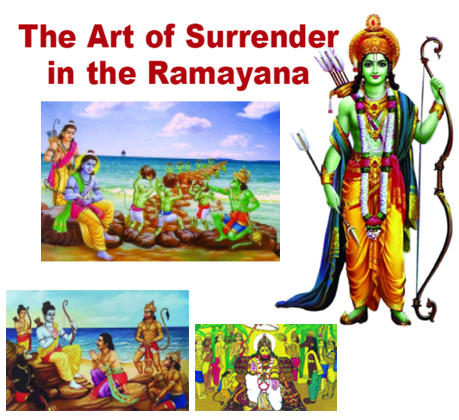

The Ramayana is not merely a narrative of heroism and exile – it is, at its deepest level, a treatise on Saranagati, the art of complete surrender to the Divine.
Why did Lord Narayana choose to incarnate not alone but alongside three brothers? Sri Desika Srinivasa Tathacharya Swami, in his exposition of the Ramayana’s layered meanings, offers a compelling answer: each brother arrived
with a distinct spiritual purpose. Rama embodied absolute fidelity to His father’s word. Lakshmana demonstrated how a devotee should worship and serve the Lord with unwavering dedication. Bharata illuminated the importance of reverence
toward the Acharya – his worship of the divine sandals, which symbolise the Guru, is among the most celebrated acts of devotion in the epic. And Shatrughna exemplified the ideal of serving the Lord’s devotees, completing a framework in which every dimension of righteous conduct finds its living model.
The Ocean’s Silence
One of the Ramayana’s most revealing episodes unfolds at the shore of the ocean. When Rama sought passage to Lanka, He performed Saranagati before Samudra Raja, lying on a bed of grass for three days in humble supplication. Yet the ocean did
not respond immediately. The Acharyas explain this through the very theology of surrender: genuine Saranagati requires two qualities in the one who surrenders – Akinchanyam, the recognition that one possesses nothing of one’s own, and
Ananyagatitva, the acknowledgment that no other refuge exists. Rama, being the Supreme Lord Himself and the very source of all power, did not outwardly fulfil these conditions – and so the ocean hesitated. The episode thus becomes a teaching moment, clarifying the inner prerequisites of true surrender for all who seek it.
Refuge and Compassion
When Vibhishana approached Rama seeking refuge, several among Rama’s companions voiced reservations. It was Hanuman who counselled acceptance, pointing out that in the Ashokavana, Vibhishana’s own family had shown kindness and support to
Sita during her time of distress. Compassion and prior goodness, Hanuman argued, deserved recognition.
Steadfast Faith
Sita’s conduct throughout her ordeal stands as the Ramayana’s most profound portrait of a surrendered soul – unwavering in faith, constant in remembrance of the Lord, and entirely dependent on divine grace through every trial.
Hanuman, across these episodes, emerges as the Acharya – the guiding force who facilitates surrender, bridges the distance between the soul and the Divine, and lives the doctrine he teaches. In the Ramayana’s vision, the path to liberation is never walked alone; it is the Acharya who lights the way.


Add Comment