



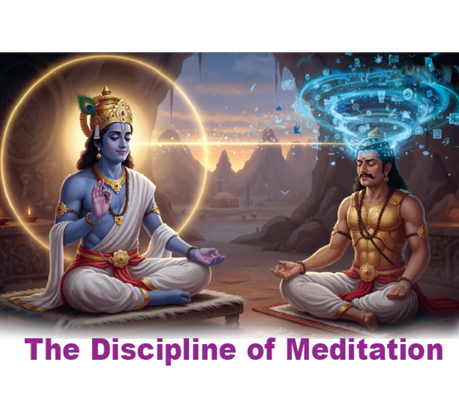

The Bhagavad Gita, or the “Song of God,” is one of the most revered texts in Indian philosophy. Delivered by Lord Shree Krishna to Arjun on the eve of the great war of the
Mahabharata, it is more than a battlefield dialogue. It is a spiritual guide, a manual on life, and a timeless meditation on duty, righteousness, and the search for truth.
Composed of 18 chapters, the Gita explores paths of devotion, wisdom, discipline, and action, weaving them into a vision of harmony between worldly responsibilities
and spiritual liberation.
In this sixth chapter of the Bhagavad Gita, Shree Krishna continues to guide Arjun through one of the most profound teachings of the scripture-the discipline of meditation and the mastery of
the mind. This chapter, known as Dhyana Yoga or the Yoga of Meditation, offers a detailed analysis of the spiritual journey, the nature of the mind, and the role of discipline, effort, and devotion.
While the Gita is often celebrated for its call to action, Chapter 6 reveals that true action gains value only when guided by an inner stillness. It is here that Krishna lays
out a practical spiritual roadmap combining work, restraint, meditation, and devotion.
Krishna begins by comparing two approaches to spiritual life: karm yog, the path of performing prescribed duties without attachment, and karm sanyas, the path of external renunciation. He clarifies
that real renunciation is not the abandonment of action but the abandonment of the desire for results. Those who perform their duties selflessly are true renunciates.
External withdrawal from the world, if not accompanied by inner purification, achieves little. The strength of karm yog lies in its accessibility-it allows one to progress spiritually while remaining
fully engaged in life. Through dedicated work performed in the right spirit, the mind becomes purified, achieving a natural calmness that prepares it for deeper meditation.
A central theme of this chapter is the power and complexity of the human mind. Krishna explains that the mind can be one’s greatest ally or one’s most dangerous adversary.
A trained mind uplifts, strengthens, and protects the seeker, while an untrained mind may create obstacles, confusion, and self-sabotage. For this reason, meditation becomes essential.
By repeatedly bringing the mind back to a single point of focus, the spiritual aspirant gradually overcomes internal turbulence.
Krishna warns Arjun that extreme austerities or imbalanced living do not assist this journey.
Spiritual progress requires moderation-in food, sleep, work, recreation, and rest. Discipline must be steady, not severe. Just as a healthy body requires balance, a stable mind demands it even more.
Once the mind becomes steady, the seeker experiences an inner joy independent of external circumstances. In this state of samadhi, the soul is clearly perceived and the practitioner feels
united with the divine. Krishna describes this spiritual absorption as a state of supreme bliss, unshaken even by life’s greatest calamities. Nothing in the material
world can surpass its fulfillment. This union with the Self, free from misery, is what Krishna defines as true Yoga, not physical postures or rituals, but the cessation of suffering
through inner transformation.
Arjun, practical and sincere, confesses that controlling the mind appears impossible. The mind, he says, is more restless than the wind. Krishna does not reject this observation; instead, he agrees
wholeheartedly. Yes, the mind is difficult to control-but not impossible.
Through abhyasa (long-term, consistent practice) and vairagya (detachment), mastery becomes attainable. These two pillars form the psychological foundation of the spiritual path.
Practice strengthens focus; detachment weakens the pull of distractions. Over time, the mind, once agitated and stubborn, learns to cooperate.
Arjun then raises a compassionate doubt. What happens to those who begin their spiritual journey sincerely but struggle to complete it in this lifetime? Are their efforts
wasted? Do they fall between worldly success and spiritual realization, gaining neither? Krishna reassures him with profound kindness:
no spiritual effort is ever lost. The universe keeps an account of every sincere attempt, every moment of longing, every step taken toward the divine. Even if one falls short, these impressions
reappear in future births. Such souls are reborn in circumstances that help them resume their unfinished journey-either in prosperous, virtuous families or in households where spiritual wisdom is
natural and abundant. Their past discipline draws them instinctively toward God, often without deliberate effort. Their progress continues from exactly where they left off, allowing them to attain perfection
more swiftly.
With this assurance, Krishna concludes the chapter by ranking the various seekers.
He notes that the yogi is superior to the ascetic who merely performs austerities, to the scholar who only grasps intellectual knowledge, and to the ritualist who performs
ceremonies mechanically. True Yoga is the path of inner union, not outer display. Among all yogis, the one who, with deep faith and unwavering love, keeps the mind absorbed in God is the highest.
This figure is the pinnacle of spiritual evolution-the meditator whose heart is filled with devotion. In this way, Krishna gracefully connects meditation with bhakti,
revealing that the culmination of disciplined introspection is loving surrender.
Chapter 6 of the Bhagavad Gita thus stands as a comprehensive guide to the subtle art of mind-control, balanced living, and devoted meditation. It teaches that spiritual
progress does not require escape from the world, but engagement with awareness. It urges us to cultivate a mind that supports our growth rather than obstructs it.
And above all, it reminds us that every sincere effort, no matter how small, moves us closer to the divine. For the seeker striving to reconcile worldly duties with inner
aspiration, Dhyana Yoga offers both clarity and comfort: work without attachment, live with balance, train the mind with patience, and ultimately, let love for the
divine guide the way.


Add Comment