



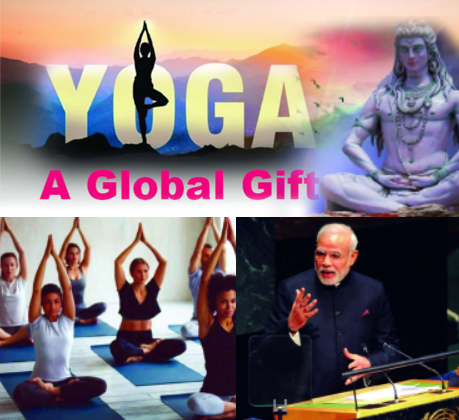

On Sunday, June 21, 2026, the world will mark the twelfth International Day of
Yoga – a celebration that began with a speech at the United Nations and now reaches an estimated two billion practitioners across the globe.
There are few cultural gifts from any single civilisation that have been embraced as universally as yoga. What began thousands of years ago on the Indian subcontinent as a discipline uniting body, breath, and consciousness is now
practised in living rooms and parks, hospitals and corporate offices, schools and military bases, in virtually every country on Earth. The International Day of Yoga, observed annually on June 21, is both a recognition of that
extraordinary journey and an invitation to continue it.
The Road to the United Nations
The idea of a dedicated global day for yoga was formally proposed by India’s Prime Minister Narendra Modi during his address to the 69th session of the United Nations General Assembly on September 27, 2014. In that speech, he
described yoga as “an invaluable gift from our ancient tradition” and “a holistic approach to health and well-being” that embodies the unity of mind and body, thought and action, harmony between human beings and nature.
What followed was remarkable for its speed and scale. India’s Permanent Representative to the UN, Ambassador Asoke Kumar Mukerji, introduced the draft resolution to the General Assembly on December 11, 2014. It was adopted
unanimously, without a vote. A total of 175 member states cosponsored the resolution – the highest number of co-sponsors ever recorded for any UN General Assembly resolution of its kind. The entire process, from proposal to adoption,
took fewer than 90 days, itself a record for such an initiative at the UN.
initiative at the UN. The first International Day of Yoga was celebrated on June 21, 2015, with millions of participants across the world – from the lawns of the UN headquarters in New York to public gatherings in Paris, Beijing, Bangkok,
Seoul, and New Delhi.
Why June 21
The date was chosen with deliberate significance. June 21 is the summer solstice in the Northern Hemisphere – the longest day of the year, symbolising light, vitality, and energy. In Indian tradition, the solstice holds additional
meaning. It marks the beginning of Dakshinayana, the Sun’s southward journey, a period considered especially conducive to spiritual practice.
According to yogic lore, it was around this time that Shiva, regarded as the Adi Yogi (the first yogi), is said to have begun transmitting the knowledge of yoga, thus becoming the Adi Guru (the first teacher). The first full moon after the
summer solstice is celebrated as Guru Purnima.
Roots in Antiquity
Yoga’s origins stretch back over five thousand years, with references found in the pre-Vedic and Vedic traditions of India. The sage Patanjali is credited with systematising yoga into a structured framework through the Yoga Sutras, which
outline the eight limbs (Ashtanga) of yoga: Yama (ethical conduct), Niyama (self-discipline), Asana (physical postures), Pranayama (breath regulation), Pratyahara (withdrawal of senses), Dharana (concentration), Dhyana (meditation),
and Samadhi (a state of profound inner absorption). This comprehensive architecture makes clear that yoga was never conceived as mere physical exercise – it encompasses moral, mental, and spiritual dimensions of human life. Over the
centuries, yoga evolved through various schools and traditions. Teachers such as Swami Vivekananda, who addressed the Parliament of Religions in Chicago in 1893, Tirumalai Krishnamacharya, B.K.S. Iyengar, K. Pattabhi Jois, and many others
played pivotal roles in bringing yoga to global attention during the twentieth century.
A Global Footprint
Today, an estimated two billion people practise yoga worldwide. The World Health Organization has recognised physical inactivity as one of the top ten leading causes of death globally and has actively endorsed yoga as a tool for healthier
living. In collaboration with the Government of India, WHO launched the mYoga app, a free digital resource offering guided yoga instruction to users everywhere.
The United Nations Postal Administration issued a set of ten stamps depicting yoga asanas in 2017. India’s Reserve Bank issued a commemorative ten-rupee coin in 2015 to mark the first International Day of Yoga. Each year, the observance
carries a specific theme – past themes have included “Yoga for Humanity” (2022), “Yoga for Vasudhaiva Kutumbakam” (2023, reflecting the ancient Indian philosophy that the world is one family), and “Yoga for One Earth, One Health” (2025).
Interesting Facts
For the Indian diaspora, the International Day of Yoga carries a particular sense of pride. It represents one of the most visible examples of India’s cultural heritage gaining formal global recognition. Across the United States,
yoga studios, Indian consulates, community organisations, and university groups host special sessions and events on the day. For many NRI families, it is also an opportunity to share a piece of their heritage with neighbours and colleagues
- a practice that transcends language, religion, and geography.
The resolution establishing International Day of Yoga was the fastest-ever implementation of a country-initiated proposal at the UN General Assembly, completed in under 90 days. The word yoga derives from the Sanskrit root yuj,
meaning “to unite” or “to join.” Yoga is practised in more than 190 countries. India’s Ministry of AYUSH, established in 2014, is the world’s only dedicated government ministry for traditional and alternative medicine systems including yoga. The International Day of Yoga logo, launched in 2015, features a human figure in a yoga posture with folded hands, set against a backdrop of green and
brown leaves symbolising the connection between humanity and nature, with a globe representing universality.
What makes yoga enduring is its adaptability. It meets each person where they are – whether that is on a mat in a Manhattan apartment, at a community centre in Chennai, or on a riverbank in Rishikesh. It asks for nothing more than
attention and breath, and offers in return a pathway to physical health, mental clarity, and a deeper awareness of one’s place in the world.
On June 21, 2026, that invitation stands open once again – as it has for millennia.


Add Comment