



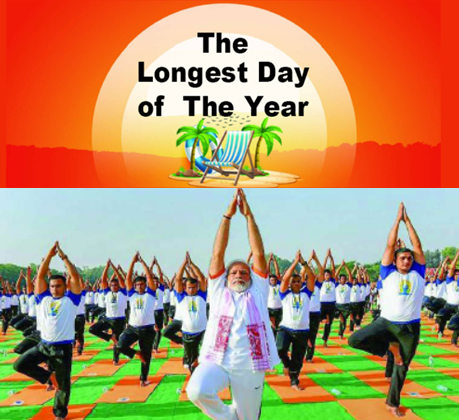

On June 21, 2026, the Northern Hemisphere will experience its longest stretch of daylight – an event that has shaped calendars, crops, and cultures for thousands of years.
There is a moment each year when the Earth leans closest toward the Sun, tilting at its maximum angle of roughly 23.5 degrees, placing the Sun directly over the Tropic of Cancer. That moment is the summer solstice – and in 2026, it arrives
on Sunday, June 21. For the nearly 90 percent of the world’s population that lives north of the equator, it will be the longest day of the year. In Houston, for instance, the Sun will rise at 6:21 AM and set at 8:25 PM, offering over
fourteen hours of daylight. In Fairbanks, Alaska, the Sun barely dips below the horizon at all.
But the solstice is far more than an entry on an astronomical calendar. It is one of humanity’s oldest shared experiences – a celestial hinge around which civilisations have organised their agriculture, their worship, and their sense
of time itself.
What Happens, and Why
The word “solstice” comes from the Latin sol (sun) and sistere (to stand still). On this day, the Sun’s northward journey across the sky pauses, appearing to hover at its highest point before reversing direction and beginning its slow
retreat southward. It is the apex of light – after which days gradually shorten until the winter solstice in December restores the cycle.
This happens not because the Sun moves, but because the Earth’s axis is tilted. As our planet orbits the Sun over the course of a year, that fixed tilt means different hemispheres receive different intensities of sunlight at different
times. When the North Pole is angled most directly toward the Sun, the Northern Hemisphere gets its summer solstice. The Southern Hemisphere, meanwhile, experiences its shortest day and the depth of winter.
Ancient Roots, Living Traditions
solstice for millennia. Some of the earliest evidence comes from the Nabta Playa stone circle in southern Egypt, dating back over six thousand years, where stones were arranged to align with the Sun’s trajectory. The builders of Stonehenge, around 2500 BCE, positioned their massive sarsen stones so that the
summer solstice sunrise appears directly over the Heel Stone when viewed from the monument’s centre – an alignment that still draws thousands of visitors each year.
Ancient Egyptians noted that the solstice roughly coincided with the annual flooding of the Nile, a life-giving event that deposited fertile silt across the narrow strip of farmland sustaining their entire civilisation. In Greece, the
festival of Kronia honoured the god Kronos and evoked a mythical golden age when the earth provided abundantly without human toil. Across Northern and Central Europe, Celtic, Slavic, and Germanic communities lit enormous bonfires intended
to bolster the Sun’s energy through the remainder of the growing season.
Many of these traditions survive in evolved forms. Sweden’s Midsommar celebration remains one of the country’s most beloved holidays, with maypole dances, pickled herring, and strawberries with cream. In Finland, families
retreat to lakeside cottages for bonfires and saunas during Juhannus. Latvia marks its J??i Festival, and Lithuania celebrates Jonin?s with fortunetelling, garlands, and dancing – traditions stretching back to the Middle Ages. In parts of Eastern Europe, the solstice is linked to Ivan Kupala Night, a Slavic celebration steeped in romance, with flowered wreaths floated on rivers and couples leaping over fires.
The Indian Connection
For Indians and the diaspora, the solstice carries its own layer of significance. In Hindu astronomy, the summer solstice marks the beginning of Tropical Dakshinayana, the Sun’s southward journey. While the sidereal version
is calculated differently and begins with Karka Sankranti, the solstice itself holds deep resonance as a marker of cosmic rhythm. In Vedic tradition, the six months following the solstice are associated with spiritual practice of a
different character than the preceding six. And since 2015, June 21 has doubled as the International Day of Yoga – a recognition of India’s gift to global wellness, celebrated with mass sessions in parks and plazas from New Delhi to New York.
Surprising Facts Worth Knowing
Despite being the longest day, the solstice is not the hottest. In most of the Northern Hemisphere, peak temperatures arrive in July or August, because the atmosphere continues to absorb more heat
than it loses for several weeks after the solstice. Interestingly, the earliest sunrise and latest sunset do not actually fall on the solstice day either – they are typically spread across early and late June,
depending on latitude. And while the Sun’s strongest visible emission is green light, which is why human eyes are most sensitive to that colour, the Sun’s most powerful emission overall is actually infrared – the invisible radiation we feel as warmth on our skin.
In an age of electric light and climate- controlled offices, it is easy to lose awareness of the Sun’s rhythms. But the solstice reminds us that we live on a tilted, spinning planet whose relationship with its star governs everything from
harvests to holidays. Whether you mark the day with yoga at dawn, a backyard barbecue at dusk, or simply a moment of gratitude for the extra light, you are participating in a tradition as old as civilisation itself. The Sun stands still
– and invites us to notice.


Add Comment