


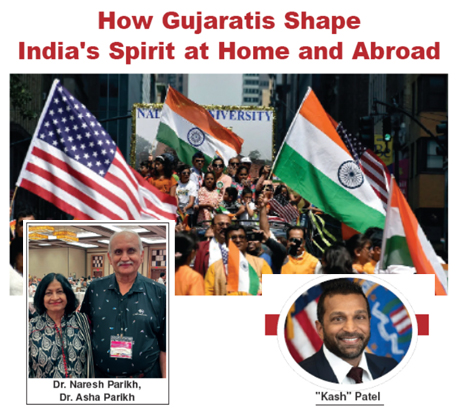

Dr. Naresh Parikh,
Dr. Asha Parikh
The United States is home to about 1.6 million Indian immigrants, making them the third-largest immigrant group in the country. Among them, Gujaratis form one of the most vibrant and visible communities – key voices in policy, public
service, healthcare, education, and technology. From founding hospitals and mentoring students to shaping local politics and national security decisions, Gujaratis show how an immigrant community can not only preserve its heritage but also
shape the future.
From quiet neighborhoods in New Jersey to medical centers in Florida and community halls in Chicago, the Gujarati journey is one of grit, learning, and giving back. It’s a testament to how values travel thousands of miles and stay rooted in
daily life. One of the clearest examples of this commitment is healthcare. Walk through hospitals, clinics, or medical conferences, and you’ll find Gujaratiorigin doctors bridging two worlds with their work.
Doctors like Dr. Naresh Parikh, Dr. Asha Parikh, Dr. Sudhir Parikh, Dr. Kiran Patel, Ajeet Kothary, Dr. Shirish Patel, Dr. Gunjan Shukla, Dr. Dalsukh Madia, Dr. Mukesh Patel, Dr. Sumul Raval, Dr. Raj Bhayani, and Dr. Vinod Shah reminds us
that professional excellence goes hand in hand with community responsibility. Whether building hospitals, supporting medical students, or mentoring the next generation, their contributions echo far beyond clinic walls. Many of these doctors
are part of a wider network of Gujarati Americans who have spent decades bridging India and the United States not just through medicine, but also through philanthropy and public service. In rural Gujarat, they help modernise schools, sponsor clean water, and support rural health, turning
success abroad into hope at home.
Beyond healthcare, Gujaratis are leaving their mark in American policy circles too. Raj Shah, for instance, served as White House Deputy Press Secretary, showing how second- generation Gujaratis are stepping into influential roles. Kashyap
“Kash” Patel, another Indian American with Gujarati roots, rose to senior national security positions, advising on defense and intelligence. For young Gujaratis growing up in America, these stories prove that public service is not out of
reach.
In science and exploration, Sunita Williams, whose Gujarati heritage comes through her father, Dr. Deepak Pandya, is one of NASA’s most recognized astronauts. With over 300 days in space and missions aboard the International Space Station,
she shows how curiosity and learning can break barriers that once seemed impossible.
There are many timeless ideals as well. Decades ago, Mahatma Gandhi’s message of nonviolence inspired millions to believe moral courage could defeat empires. Sardar Vallabhbhai Patel’s determination to unify hundreds of princely states
showed the power of collective vision. Today, Prime Minister Narendra Modi’s call for a Viksit Bharat, a self-reliant, developed India, builds on this legacy of inclusive growth. For Gujaratis abroad, this vision turns nostalgia for home
into real investments in villages, schools, and local projects.
What truly makes Gujaratis thrive worldwide is a quiet faith in seva, selfless service. This spirit lives not just in hospitals or policy rooms, but also in daily acts that rarely make headlines. Temple volunteers, teachers, nonprofit
founders, and student mentors all share the belief that prosperity means little if it doesn’t lift others too.
When disasters strike, Gujaratis abroad mobilize quickly, raising funds, sending relief, and rebuilding lives. After the Gujarat earthquake, they raised millions and sent medical teams to restore entire villages. That same spirit continues
today, whether through scholarships for students or free clinics for the uninsured.
From parents to children, this idea of giving back stays strong:
that success without purpose is hollow, and that the greatest legacy is to help others rise. Young Gujaratis are carrying this forward, founding startups that give back, building community health centers, and stepping into civic roles that
shape local and national policy. They stand at a unique crossroads, carrying the weight of peace, vision of unity, and idea for a confident India, but also the tools of modernity: science, education, and the drive to lead. In boardrooms,
labs, universities, and community halls, they prove faith and progress can grow together.
From a surgeon’s office in Florida to a scholarship awarded in Saurashtra, they remind us that the Gujarati story is not just about success, but about lighting the way for others too, with an enduring sense of dharma: and bridge worlds, no
matter where in the world they build their lives.




Add Comment